

Global Action Community Newsletter
Not all nicotine products carry the same health risks—so what would a framework for quitting smoking based on those relative risks look like? In a nutshell: tobacco harm reduction.
Harm reduction generally acknowledges that some behaviors exist along a continuum of risk, and that individuals can take steps to lower their risk if they choose to engage in those behaviors. For example, drug harm reduction includes syringe service programs, overdose prevention measures, and medication-assisted treatment. These interventions aim to reduce the most serious harms associated with substance use—without requiring or discouraging abstinence.
Tobacco harm reduction (THR) applies the same logic. It doesn’t require, or even necessarily encourage, complete abstinence from nicotine. Instead, it focuses on helping people move away from the riskiest behavior: smoking combustible cigarettes. The only goal is to help people stop smoking—however they choose to do it.
Traditional smoking cessation programs often rely on nicotine replacement therapies, like patches or gum, to help reduce cravings. That’s actually one form of tobacco harm reduction. Using e-cigarettes or nicotine pouches is another. In all of these cases, the individual is switching to a less risky way of using nicotine.
I spent the early years of my career focused on drug harm reduction—specifically, working alongside people who used injection drugs to reduce their risks of HIV and hepatitis C. I liked being part of a public health solution that collaborated with individuals who needed personalized support, rather than telling them what to do from afar.
Submit a question on the latest quitting research, and we may answer it in an upcoming newsletter.
CLICK HERE TO SEND US YOUR ANSWER
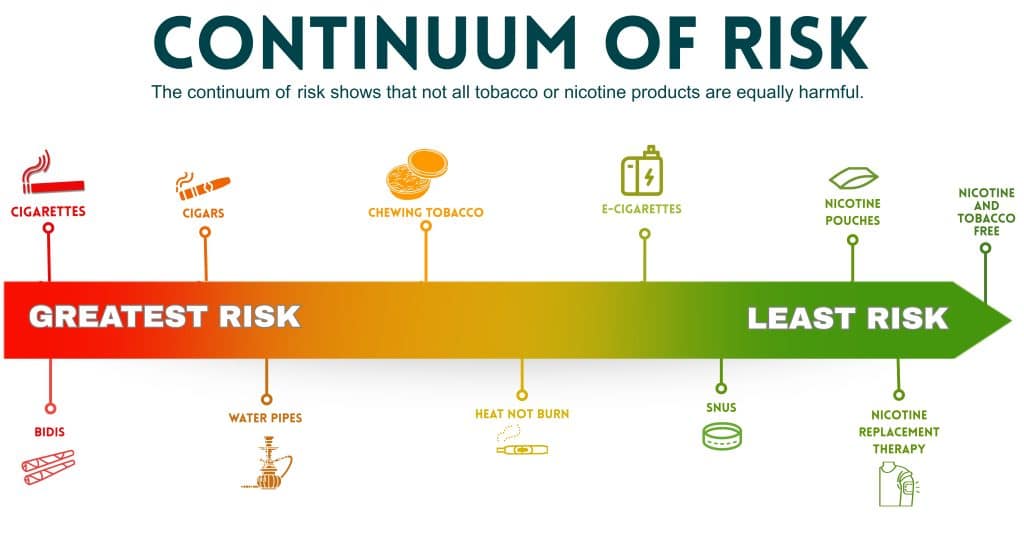
Image citations: Murket et al. 2022, Knowledge Action Change, 2020, and Kozlowski and Abrams, 2016.
Over time, it became clear to me that the concept of harm reduction should be applied to other areas, including nicotine use. After all, the individuals I worked with are 1.5 to 3 times more likely to smoke than the general population.
Global Action to End Smoking is one of the few public health groups dedicated to ending smoking that fully embraces tobacco harm reduction (THR). We recognize that nicotine products fall along a continuum of risk. While using no nicotine products is the safest option, we also understand that may not be possible for everyone who struggles to quit smoking—and that some adults may choose to use nicotine in the long run.
Like traditional smoking cessation groups, we believe that youth must be protected from nicotine addiction in any form. But it’s clear to us that new solutions are needed to meet the needs of more than one billion people worldwide who still smoke cigarettes.
Global Action funds projects that empower adults to move down the continuum of risk with accurate information about the different health risks of various tobacco and nicotine products. Currently, we’re working with groups like the National Harm Reduction Coalition to integrate THR into existing drug harm reduction initiatives.
This is just the beginning. There’s so much more to do in this space, and we’re excited to continue accelerating the end of the global smoking epidemic by working with people who smoke to reduce their risks.
All my best,
Elsa Larson, PhD, M.S
Director, Programs
Global Action to End Smoking
By the Numbers

Global Action in the news
There may be more responsibility, say, for an organization like Global Action to End Smoking … to communicate about the relative risks of nicotine with folks, and to provide unvarnished, clear, understandable information to all who may need it.
—Global Action CEO Cliff Douglas as he sat down with YouTuber Nick “Grimm” Green to discuss the future of tobacco harm reduction and how compassion for people who smoke will win in the long run.
Tobacco and health around the world

Country snapshot:South Korea
In 2022, an estimated 17.9% of the population of the Republic of Korea, including 30.9% of men and 5.1% of women, smoked cigarettes.
- Demand for cigarettes in South Korea has decreased by 45.6% since 2010. Euromonitor estimates that the demand for cigarettes per capita was reduced from 110.3 packs in 2010 to 49.6 packs in 2022.
- In 2021, 3.2% adults aged 19 years and over in the country were identified as current e-cigarette users, comprising 1.2% of women and 5% of men.
- According to the National Tobacco Control Center, smoking prevalence in adults aged 19 years and over has shown a decline from 27.1% in 2011 to 19.3% in 2021.
For references and to view other country profiles, visit our pages on
Tobacco and Health Around the World.
Thank you for your support
Give the gift of a healthier tomorrow.
We are taking bold action to find global solutions to end death and disease caused by tobacco, particularly combustible cigarettes. We are one of the only public health groups to embrace tobacco harm reduction as the best viable strategy for ending the global smoking epidemic.
We’re proud to support grantees such as Knowledge Action Change, which recently published this free course on tobacco harm reduction.
Your support makes this work possible. Together, we can build a future where no one suffers from tobacco-related disease.
Thank you for your support in the fight against smoking.
Get to Know Global Action
Global Action has awarded more than 175 grants to institutions that support the work of over 100 scientists, covering 46 countries on four continents.
Our organization is an independent, U.S. nonprofit 501(c)(3) grantmaking organization whose mission is to end combustible tobacco use, which remains the leading preventable cause of death globally. Through September 2023, Global Action received charitable gifts from PMI Global Services Inc. Global Action does not seek or accept funding from companies that produce tobacco or non-medicinal nicotine products.
To learn more about our work, visit our website.
Disclaimer: This newsletter does not provide medical advice. The information, including but not limited to, text, graphics, images and other material contained in this newsletter are for informational and educational purposes only and does not constitute providing medical advice or professional services. No material in this newsletter is intended to be a substitute for diagnosing or treating a health problem or disease. Those seeking personal medical advice should consult with a licensed physician or other qualified health care provider. Always seek the advice of your licensed physician or other qualified health care provider regarding a medical condition or with any questions you may have regarding treatment and before undertaking a new health care regimen. Never disregard professional medical advice or delay in seeking it because of something you read in this newsletter. No physician-patient relationship is created by this newsletter. Global Action doesn’t make representations, express or implied, with respect to the information provided here.