Categories
Newsletter

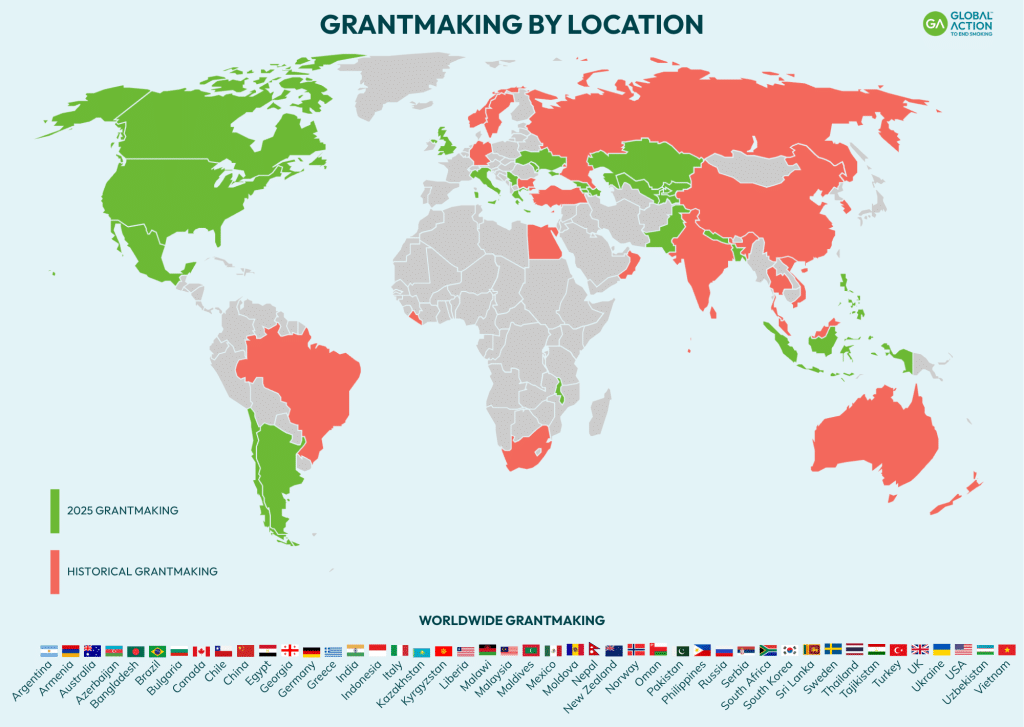
35 grants. 22 countries. One mission. 

Global Action to End Smoking Logo

Global Action Community Newsletter

Global tobacco use is at an all-time low. Now is the time to accelerate progress further.

From Queens, NY to Malawi, Africa our grantees made real progress in 2025 for all people impacted by smoking.

In recent decades, smoking rates have declined in most parts of the world. However, the reduction in smoking rates has stagnated; globally, the smoking rate remains stubbornly around 20%. As a result, even with substantial progress, smoking is still the leading preventable cause of death.

Global Action’s mission is to end combustible tobacco use globally, and we are committed to supporting all adults who smoke, no matter where they are on their journey to quit. Our grantees are working on research and initiatives to help us achieve our mission to end combustible tobacco use. This means embracing tobacco harm reduction—which includes the use of reduced-risk nicotine products like e-cigarettes or nicotine pouches—when traditional smoking cessation support isn’t enough.

I’m excited to share our 2025 Annual Report with you, which demonstrates the tremendous impact our grantees have had in the last year. With their efforts, we’re working to make sure no one who smokes gets left behind.

In 2025, we supported more than 30 grants across more than 20 countries. This research led to the publication of 14 scientific research articles and 15 working papers, and our grantees appeared at 21 conferences and in 14 media articles worldwide.

Read our 2025 annual report

A few examples of the grants we made in 2025 demonstrate how impactful our work truly is. The first is our unique grant to Northwell Health. With our funding, Northwell will expand smoking cessation support, including tobacco harm reduction, to populations with elevated smoking rates in Queens. This is the first time a major health care provider in the U.S. has integrated tobacco harm reduction into its smoking cessation and cardiovascular care programs.

The second is the completion of the GA Agricultural Transformation Centre in Malawi. We gifted this state-of-the-art facility to the Lilongwe University of Agriculture and Natural Resources in Malawi to empower smallholder farmers to transition their crops from tobacco to more environmentally and economically stable crops. Already, the GA Centre has aided more than 800,000 farmers, and we are grateful for the opportunity to leave a legacy in the country for years to come.

I’m optimistic about the momentum this work has carried through to 2026. We’re continuing our partnerships with many existing grantees and forging ahead with bold new partners who are taking creative approaches to ending combustible tobacco use.

People who smoke deserve the opportunities and resources to quit in the way that works for them. I’m confident that together, we can support the cessation journeys of all adults who smoke.

We’re so glad you’re here with us as we recognize World No Tobacco Day 2026. So much progress has been made in the fight against combustible tobacco use; now is the time to keep pushing forward. Together, we can put an end to smoking.

All my best,

Pamela Parizek

Executive Board Chair

Global Action to End Smoking
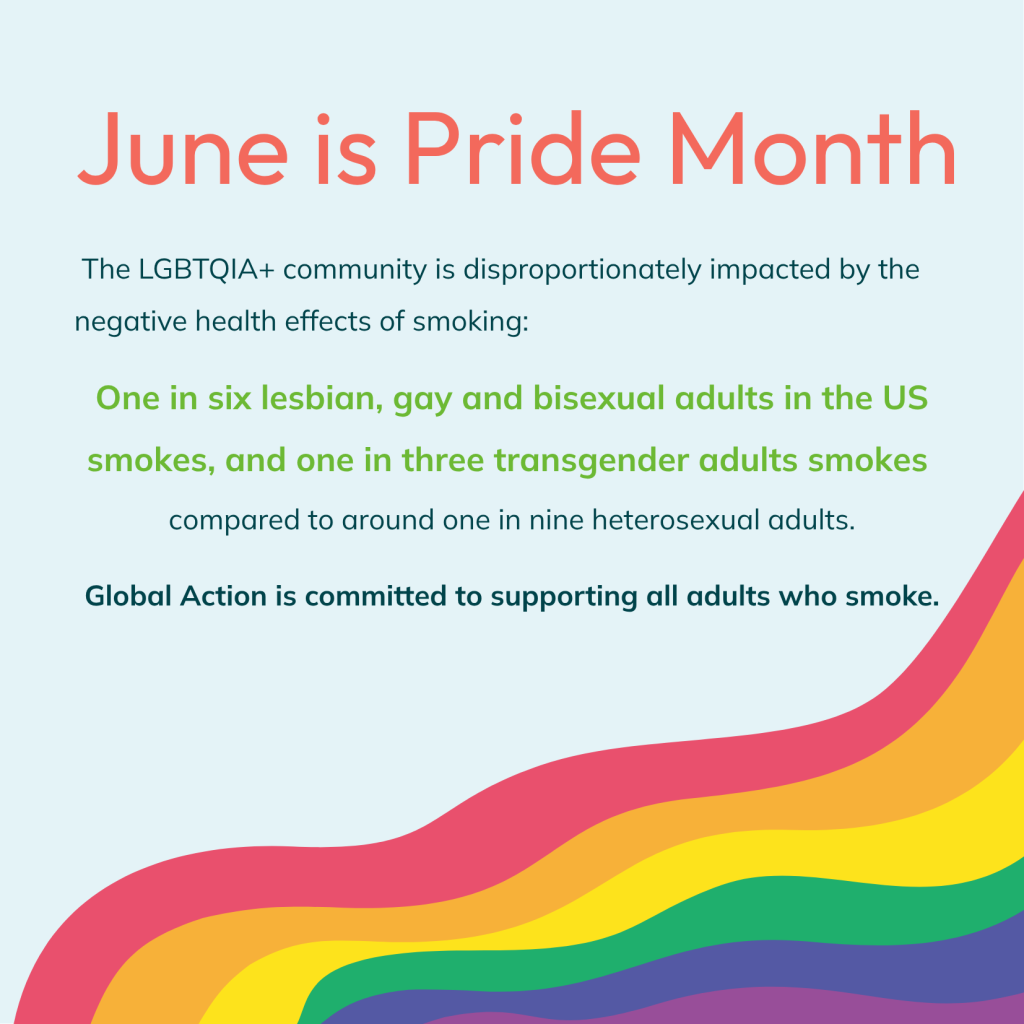
June is Pride Month - the LGBTQIA+ community is disproportionately impacted by the negative health effects of smoking. One in six lesbian, gay, or bisexual adults smokes, and one in three transgender adults smoke, compared to one in nine heterosexual adults. Global Action is committed to supporting all adults who smoke.

BY THE NUMBERS

35

The number of grants Global Action made in 2025. These grants were conducted in 22 countries, and our grantees published 14 peer-reviewed scientific articles and 15 working papers

GLOBAL ACTION ANSWERS YOUR QUESTIONS

Read our 2025 annual report

Is smoking still a public health problem?

Smoking rates have declined over the last 60 years, but progress has stagnated. Roughly 20 percent of adults across the globe continue to smoke. In the U.S., the smoking rate remains just under 10%.

Smoking rates are disproportionately high in certain populations, including those who live with mental health conditions, substance use disorders and/or chronic disease; identify as people of color or indigenous people; live in poverty; live in certain low- or middle-income countries and/or are members of the LGBTQIA+ community.

We support the cessation journeys of all people who smoke, no matter what that journey looks like. The most important aspect of quitting is just that—quitting. Making the choice to stop using nicotine entirely or to use a less harmful form of nicotine is a choice to live a longer, healthier life.

Learn more about all the ways you can quit here.

THANK YOU FOR YOUR SUPPORT

Global Action is one of the only public health groups to embrace tobacco harm reduction as a means of meeting adults who smoke where they are, showing them empathy in their individual cessation journeys, and helping them—if they cannot or will not quit—to reduce their risks of death or disease from combustible cigarettes.

Your support increases the impact our grantees’ work can have on this cause. Together, we can build a future where no one suffers from tobacco-related disease

GET TO KNOW GLOBAL ACTION

Global Action has awarded more than 175 grants to institutions that support the work of over 100 scientists, covering 46 countries on four continents.

Our organization is an independent, U.S. nonprofit 501(c)(3) grantmaking organization whose mission is to end combustible tobacco use, which remains the leading preventable cause of death globally. Through September 2023, Global Action received charitable gifts from PMI Global Services Inc. Global Action does not seek or accept funding from companies that produce tobacco or non-medicinal nicotine products.

To learn more about our work, visit our website.

Disclaimer: This newsletter does not provide medical advice. The information, including but not limited to, text, graphics, images and other material contained in this newsletter are for informational and educational purposes only and does not constitute providing medical advice or professional services. No material in this newsletter is intended to be a substitute for diagnosing or treating a health problem or disease. Those seeking personal medical advice should consult with a licensed physician or other qualified health care provider. Always seek the advice of your licensed physician or other qualified health care provider regarding a medical condition or with any questions you may have regarding treatment and before undertaking a new health care regimen. Never disregard professional medical advice or delay in seeking it because of something you read in this newsletter. No physician-patient relationship is created by this newsletter. Global Action doesn’t make representations, express or implied, with respect to the information provided here.
Categories
Newsletter

Global tobacco use is at an all-time low. Now is the time to accelerate progress further.

Global Action to End Smoking Logo

Global Action Community Newsletter

Global tobacco use is at an all-time low. Now is the time to accelerate progress further.

Almost 40 years ago, the World Health Organization (WHO) recognized the first World No Tobacco Day. At the time, smoking was ubiquitous, with roughly four out of ten adults smoking regularly.

As we approach World No Tobacco Day 2026, we have a lot to celebrate: Today, the WHO reports that just under 20% of adults smoke. This massive public health achievement has been made possible by the cooperation of public health leaders, health care providers, scientists, regulators, and the millions of people who smoked and successfully quit. By working together, we have all reduced the toll of the leading preventable cause of death.

But now is not the time to back down: Roughly 1.3 billion people continue to smoke—and within this figure, major disparities persist: for example, four out of five adults who smoke live in low- or middle-income countries. Additionally, those who are living with serious mental illness or substance use disorders are also disproportionately likely to smoke, as are older adults, veterans, racial and ethnic minorities, and gender and sexual minorities. 

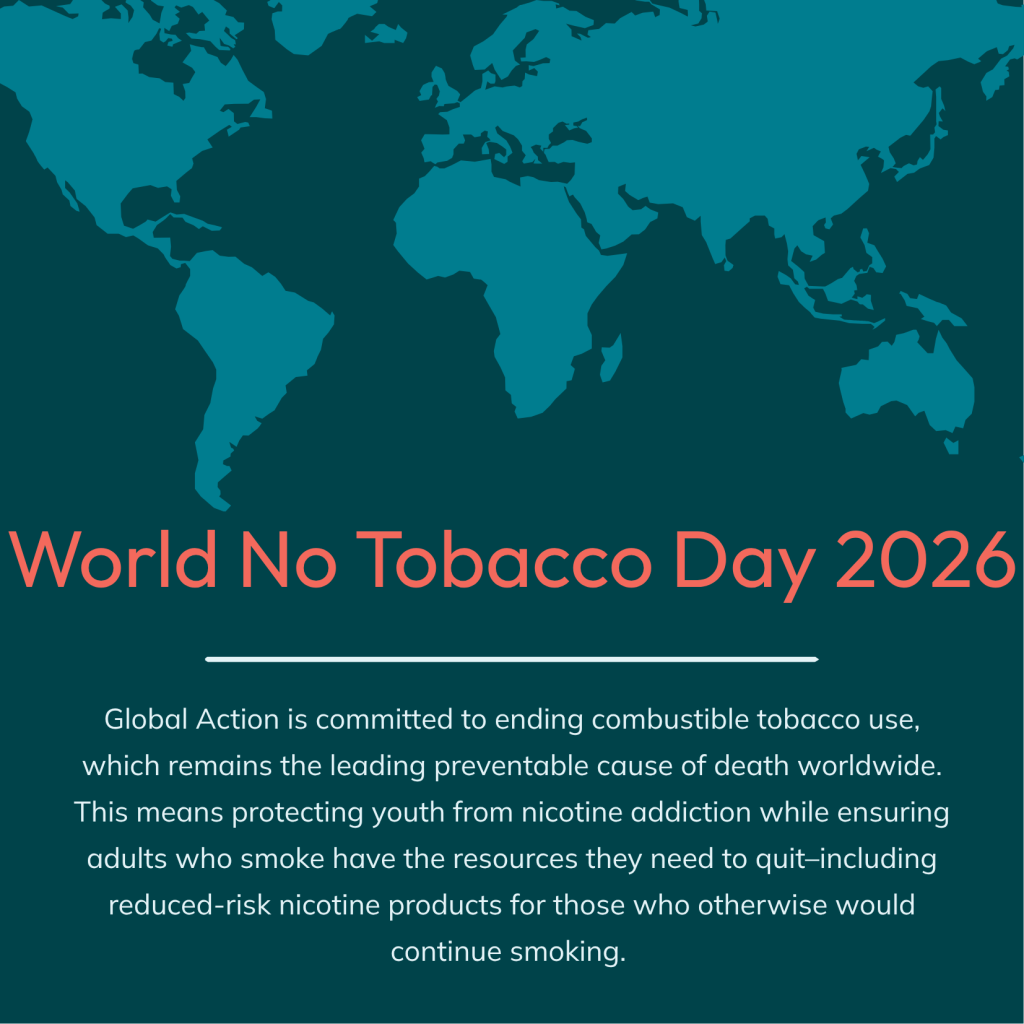
An image with an illustrated map and the text: World No Tobacco Day 2026 Global Action is committed to ending combustible tobacco use, which remains the leading preventable cause of death worldwide. This means protecting youth from nicotine addiction while ensuring adults who smoke have the resources they need to quit–including reduced-risk nicotine products for those who otherwise would continue smoking.

At Global Action to End Smoking, we believe that all adults who smoke deserve compassion. We support the cessation efforts of all people who smoke, no matter how long they’ve been smoking, if they’ve tried to quit previously, or if they’re just beginning to explore what life without cigarettes could look like.

We are a nonprofit charitable grantmaking organization that funds research and initiatives in service of ending combustible tobacco use for good. To date, we’ve awarded more than 175 grants to institutions that have enabled the work of over 100 scientists, covering 49 countries on six continents.

Our grantees tackle the complex problem of smoking from all angles.

For example, our grantees include those who have taught more than 800,000 smallholder farmers in Malawi how to transition away from farming tobacco to grow more economically and environmentally sustainable crops as demand for cigarettes wanes. Others have analyzed the real-world economic impact of policies designed to curb smoking rates. And in several parts of the world, our grantees have provided training for health care providers and community leaders to support adults who are trying to quit.

A static map of the world with countries where Global Action's grantees have been active in 2025 or previously. Global Action's grantees have worked in Argentina, Armedia, Australia, Azerbaijan, Bangladesh, Brazil, Bulgaria, Canada, Chile, China, Egypt, Georgia, Germany, Greece, India, Indonesia, Italy, Kazakhstan, Kyrgyzstan, Liberia, Malawi, Malaysia, Maldives, Mexico, Moldova, Nepal, New Zealand, Norway, Oman, Pakistan, Philippines, Russia, Serbia, South Africa, South Korea, Sri Lanka, Sweden, Thailand, Tajikistan, Turkey, UK, Ukraine, USA, Uzbekistan, Vietnam. Countries where GA has not yet been active are grey.

We’re so glad you’re here with us as we recognize World No Tobacco Day 2026. So much progress has been made in the fight against combustible tobacco use; now is the time to keep pushing forward. Together, we can put an end to smoking.

All my best,

Katherine Ellen Foley, M.A.

Senior Director, Communications

Global Action to End Smoking

GET TO KNOW OUR GRANTEES

Our focus is on making evidence-based guidance on smoking cessation and harm reduction approaches more practical and accessible.

— Dr. Deepti Bandaru from the Centre for Health Research & Education

GLOBAL ACTION ANSWERS YOUR QUESTIONS

Why is smoking so dangerous, anyway?

Smoking a cigarette burns tobacco leaves, which releases hundreds of chemicals into your lungs. Hundreds of these chemicals are known to cause long-term health problems, including many forms of cancer, heart disease, reproductive challenges, and more.

Nicotine is one of the chemicals found in tobacco. It is a highly addictive stimulant. Though it is not as dangerous as many of the other chemicals found in cigarettes, it is what makes smoking addictive and extremely difficult to quit.

If you want to quit smoking, nicotine replacement therapies like gum, the patch, or lozenges can help you weather nicotine cravings. Counseling and certain medications can also help you break the habit.

However, for many people these solutions aren’t enough. If a person can’t or won’t quit smoking in these ways, less harmful products containing nicotine—like e-cigarettes or nicotine pouches—may be appropriate.

These products aren’t entirely safe, but they don’t contain many of the harmful chemicals found in cigarettes. Many health authorities, including the U.S. Food and Drug Administration and the UK’s National Health System, say that these tools are an appropriate solution for adults who smoke and want to improve their health by switching entirely.

There is no right way to quit smoking; the best way is the one that works for you.

THANK YOU FOR YOUR SUPPORT

Global Action is one of the only public health groups to embrace tobacco harm reduction as a means of meeting adults who smoke where they are, showing them empathy in their individual cessation journeys, and helping them—if they cannot or will not quit—to reduce their risks of death or disease from combustible cigarettes.

Your support increases the impact our grantees’ work can have on this cause. Together, we can build a future where no one suffers from tobacco-related disease

GET TO KNOW GLOBAL ACTION

Global Action has awarded more than 175 grants to institutions that support the work of over 100 scientists, covering 46 countries on four continents.

Our organization is an independent, U.S. nonprofit 501(c)(3) grantmaking organization whose mission is to end combustible tobacco use, which remains the leading preventable cause of death globally. Through September 2023, Global Action received charitable gifts from PMI Global Services Inc. Global Action does not seek or accept funding from companies that produce tobacco or non-medicinal nicotine products.

To learn more about our work, visit our website.

Disclaimer: This newsletter does not provide medical advice. The information, including but not limited to, text, graphics, images and other material contained in this newsletter are for informational and educational purposes only and does not constitute providing medical advice or professional services. No material in this newsletter is intended to be a substitute for diagnosing or treating a health problem or disease. Those seeking personal medical advice should consult with a licensed physician or other qualified health care provider. Always seek the advice of your licensed physician or other qualified health care provider regarding a medical condition or with any questions you may have regarding treatment and before undertaking a new health care regimen. Never disregard professional medical advice or delay in seeking it because of something you read in this newsletter. No physician-patient relationship is created by this newsletter. Global Action doesn’t make representations, express or implied, with respect to the information provided here.
Categories
Newsletter

There have never been more solutions to help you quit smoking

Global Action to End Smoking Logo

Global Action Community Newsletter

There have never been more solutions to help you quit smoking than there are today.

Quitting smoking has always been hard—and it remains the leading preventable cause of death worldwide today.

In the 1960s when scientists recognized the long-term health threats of smoking, there weren’t many options to support adults who wanted to quit. But today, you have a wide range of choices to help you on your quitting journey—which means there’s never been a better time to try to improve your health.

Nicotine is the addictive component of cigarettes. Nicotine replacement therapies have helped millions of people quit smoking by providing small amounts of nicotine to help reduce cravings as you move away from smoking.

In total, there are five kinds of nicotine replacement therapy that have been approved across the globe. These include the following forms of nicotine: 

  • Gum
  • Patches
  • Lozenges
  • Inhalers
  • Nasal sprays

There are also several medications that help people quit smoking by acting on nicotine receptors in the brain. They can reduce cravings and withdrawal symptoms. The availability of these medications may vary depending on your location, but they include the following:

  • Varenicline
  • Bupropion
  • Cytisinicline

Beyond pharmaceuticals, digital tools have extended the way adults who smoke can access support. Several smartphone apps have emerged in the past decade.

Some of these products display the amount of money you’ve saved forgoing cigarettes. Others work like cessation programs, providing advice and encouragement periodically. Advanced apps can even track and respond to location, offering tailored support when the user is near a potential trigger that might lead them to smoke.

And even more recently, a class of reduced-risk nicotine products has emerged. These products contain nicotine, and are not risk-free, but are much less harmful than cigarettes.

Reduced-risk nicotine products aren’t official smoking cessation tools, but government authorities including the US Federal Drug Administration (FDA) recognize that switching entirely to these products significantly reduce a person’s long-term health risks. Some authorized products in this category include:

  • Heated tobacco products, which electronically heat up tobacco without burning it to create an inhalable aerosol that contains nicotine.
  • E-cigarettes, which heat up liquid to produce an inhalable vapor containing nicotine.
  • Nicotine pouches, which sit between the lips and gums, allowing nicotine to be absorbed without any heating mechanism or exposure to tobacco.

The goal of quitting smoking is to improve your long-term health. That means that the best way to quit is the one that works for you.

Wherever you are on your path to quitting, keep going. Each attempt at quitting is moving you closer to a healthier life.

All my best,

Matthew Walker, DrPH

Program Officer, Global Action to End Smoking

BY THE NUMBERS

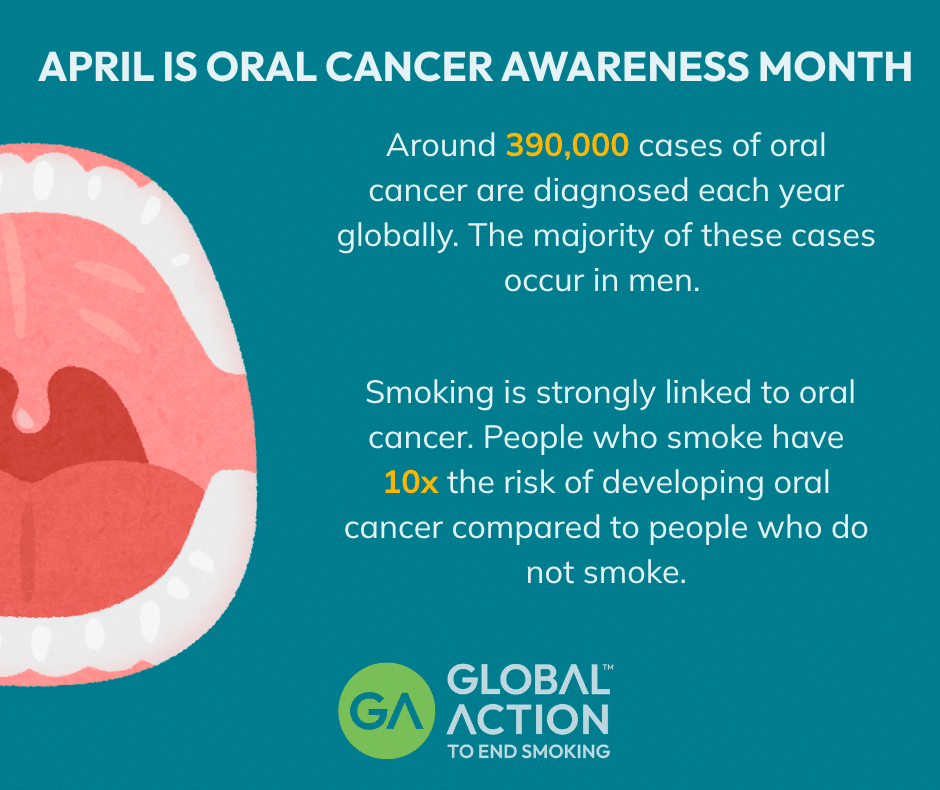
A turquoise box with the text: Around 390,000 cases of oral cancer are diagnosed each year globally. The majority of these cases occur in men. Smoking is strongly linked to oral cancer. People who smoke have 10x the risk of developing oral cancer compared to people who do not smoke. An illustrated image of a mouth appears to the left of the text.
Read the full study here. Global Action is not affiliated with this work.

GLOBAL ACTION IN THE NEWS

In April, the U.S. Food and Drug Administration reauthorized certain heated tobacco products.

With this reauthorization, the FDA allows packaging for these products to display language stating “studies have shown that switching completely from conventional cigarettes to [these products] significantly reduces your body’s exposure to harmful or potentially harmful chemicals.”

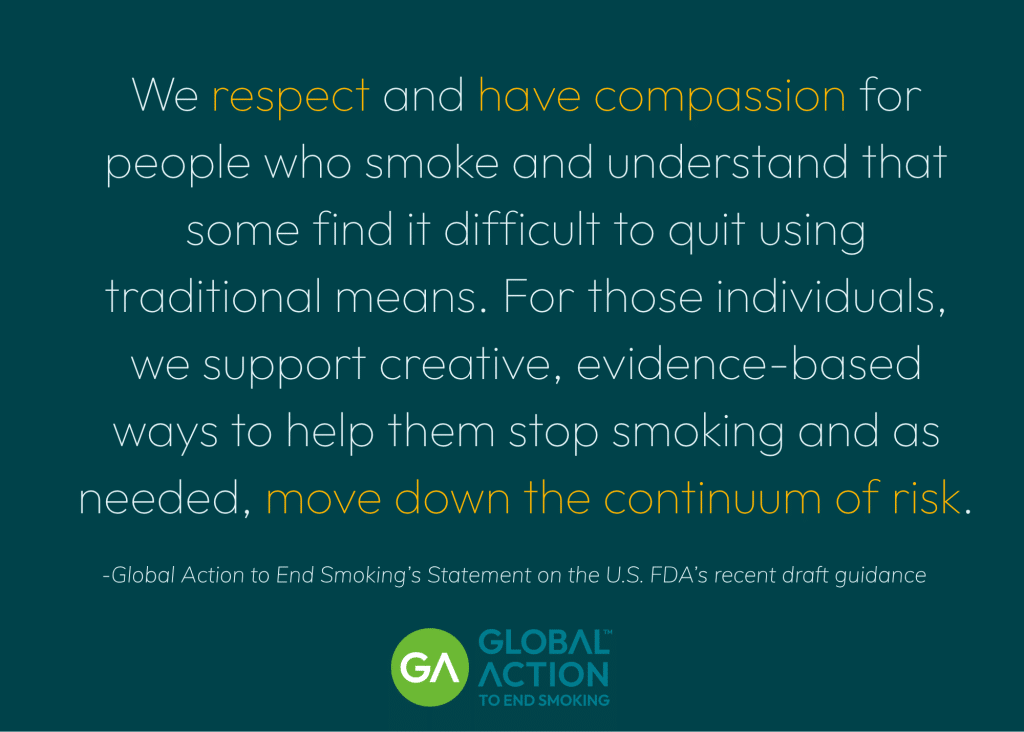
A navy blue box with the following text; We respect and have compassion for people who smoke and understand that some find it difficult to quit using traditional means. For those individuals, we support creative, evidence-based ways to help them stop smoking and as needed, move down the continuum of risk.

These reauthorizations continue to provide adults who smoke with potential solutions for their journey to quit. This decision complements Global Action’s charitable mission to end combustible tobacco use.

THANK YOU FOR YOUR SUPPORT

Global Action is one of the only public health groups to embrace tobacco harm reduction as a means of meeting adults who smoke where they are, showing them empathy in their individual cessation journeys, and helping them—if they cannot or will not quit—to reduce their risks of death or disease from combustible cigarettes.

Your support increases the impact our grantees’ work can have on this cause. Together, we can build a future where no one suffers from tobacco-related disease

GET TO KNOW GLOBAL ACTION

Global Action has awarded more than 175 grants to institutions that support the work of over 100 scientists, covering 46 countries on four continents.

Our organization is an independent, U.S. nonprofit 501(c)(3) grantmaking organization whose mission is to end combustible tobacco use, which remains the leading preventable cause of death globally. Through September 2023, Global Action received charitable gifts from PMI Global Services Inc. Global Action does not seek or accept funding from companies that produce tobacco or non-medicinal nicotine products.

To learn more about our work, visit our website.

Disclaimer: This newsletter does not provide medical advice. The information, including but not limited to, text, graphics, images and other material contained in this newsletter are for informational and educational purposes only and does not constitute providing medical advice or professional services. No material in this newsletter is intended to be a substitute for diagnosing or treating a health problem or disease. Those seeking personal medical advice should consult with a licensed physician or other qualified health care provider. Always seek the advice of your licensed physician or other qualified health care provider regarding a medical condition or with any questions you may have regarding treatment and before undertaking a new health care regimen. Never disregard professional medical advice or delay in seeking it because of something you read in this newsletter. No physician-patient relationship is created by this newsletter. Global Action doesn’t make representations, express or implied, with respect to the information provided here.
Categories
THR Updates

Global Action Commends the Reauthorization of Certain Heated Tobacco Products with Modified Risk Claims

Global Action welcomes the U.S. Food and Drug Administration’s (FDA) recent reauthorization of certain heated tobacco products. In April, the agency cleared two IQOS devices and three versions of HeatSticks to be used in these devices.

These reauthorizations continue to provide adults who smoke with potential solutions on their journey to quit. This decision complements Global Action’s charitable mission, which is to end combustible tobacco use –still the leading preventable cause of death globally.

IQOS systems heat tobacco without burning it, which significantly reduces the release of harmful compounds compared to traditional combustible cigarettes. With this reauthorization, the FDA is allowing packaging for these products to display language stating “studies have shown that switching completely from conventional cigarettes to the IQOS system significantly reduces your body’s exposure to harmful or potentially harmful chemicals.”

We respect and have compassion for people who smoke and understand that some find it difficult to  quit using traditional means. For those individuals, we support creative, evidence-based ways to help them stop smoking and as needed, move down the continuum of risk.

Global Action maintains its view that all youth must be protected from nicotine addiction and should not have access to heated tobacco products or any other products that contain nicotine. We further believe that a robust, science-backed regulatory and enforcement system is critical to ensuring those who have never used nicotine do not begin, and that all adults who smoke receive access to evidence-based education regarding tools that can help them quit or reduce their risks.

The above can be attributed to Katherine Ellen Foley, Senior Director, Communications at Global Action to End Smoking.

Source Link https://globalactiontoendsmoking.org/news-and-press/press/global-action-commends-the-reauthorization-of-certain-heated-tobacco-products-with-modified-risk-claims/

Categories
Newsletter

For the women who smoke and those who love them

Global Action to End Smoking Logo

Global Action Community Newsletter

We need to talk about women who smoke.

In my field as a family medicine practitioner and a member of the New York State Academy of Family Physicians, most of my patients who smoke are men. This reflects global trends: women make up only a fraction of the population who smokes.

By now, we all understand that smoking shortens millions of lives. But what we don’t often discuss are the differences in the way these risks impact people of different genders.*

(*To date, most of the scientific literature has classified people in the gender binary. I’m referring to men and women here for simplicity, but I understand that gender is a spectrum.)

As we reflect on Women’s History month, I want to discuss some of smoking’s unique risks to women. We must consider these differences to provide the best care for these patients and their offramp from cigarettes.

Many of the health harms of cigarettes are experienced differently in women and men. Just over a quarter of women worldwide smoke or have smoked before. These women experience most of the same smoking-related health risks as men, including higher rates of cancer and respiratory and cardiovascular diseases.

But other smoking risks are elevated for women specifically. For example, women face additional smoking-related heart health risks. Those who smoke are at a 25% greater risk of developing coronary heart disease than are men who smoke, and they’re more likely to experience a type of heart attack in which the coronary artery is completely blocked. In addition, smoking while taking birth control that contains estrogen elevates the risk of blood clots and heart attacks.

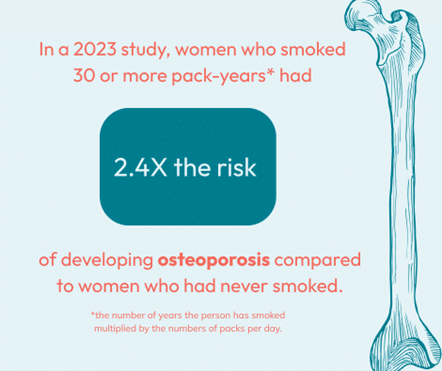
Certain health conditions that primarily afflict women are even more prevalent in women who smoke. For instance, smoking thins bones over time, increasing the risk of osteoporosis. A lifetime of smoking doubles women’s risk of infection with the virus that causes cervical cancer, and it increases the risk of death in women with breast cancer.

Smoking can also harm women’s reproductive systems. Women who smoke may be more likely to develop endometriosis, and to go through early menopause. Smoking increases the chances of complications of becoming pregnant or carrying a pregnancy, such as ectopic pregnancies and preterm delivery.

There’s also evidence that women have a harder time quitting, and that some popular cessation medications work less well for them. One recent study compared the efficacy of three first-line cessation medications: bupropion, nicotine patches, and varenicline. Varenicline was the only one of the three that was just as effective in women as in men, while the other two fell short.

While women may face extra barriers to quitting, research also shows that they have a lot to gain if the goal is achieved. In a large study, after 20 years without cigarettes the risk of sudden cardiac death among women who had smoked previously matched that of women who had never smoked. In another study, women’s lung function improved more than twice that of men’s in the first year after quitting smoking.

Women who smoke deserve healthcare that works for them. That may require providers to think outside the box. When treating women for whom past cessation attempts have failed, it may mean educating them about alternative nicotine solutions such as nicotine e-cigarettes or nicotine pouches.

These innovative solutions, combined with our growing understanding of how cigarettes impact women’s health, present us with the opportunity to provide better care and evidence-based ways to help women quit.

All my best,

Dr. Keasha Guerrier

Family Medicine Practitioner

Member, New York State Academy of Family Physicians

Dr. Keasha Guerrier is a guest contributor for Global Action’s Community Newsletter and the presentation of facts as well as opinions expressed in this article are properly attributed exclusively to Dr. Guerrier.

BY THE NUMBERS

A light blue graphic with an image of an illustrated femur bone on the left. The text reads "In a 2023 study, women who smoked 30 or more pack-years* had 2.4x the risk of developing osteoporosis compared to women who had never smoked. *The number of years the person smoke multiplied by packs per day.
Read the full study here. Global Action is not affiliated with this work.

GLOBAL ACTION IN THE NEWS

This month, the U.S. Food and Drug Administration issued draft guidance stating that certain flavored e-cigarettes could be appropriate for the protection of public health if the potential benefits to adults who smoke and want to quit outweigh any potential risk to youth.

A navy blue image with the text: Every adult who smokes has unique needs and preferences on their journey to quit. In some cases, certain flavors may increase the likelihood that a person will completely switch to less risky nicotine alternatives, thereby improving their health." The quote is a statement from Global Action to End Smoking on the US Food and Drug Administration's recent draft guidance.

Global Action believes that youth must be protected from nicotine addiction. We applaud FDA for recognizing the potential public health benefits of properly authorized and regulated alternative nicotine solutions, as these options could potentially save the lives of millions of adults who otherwise cannot or will not quit smoking. Read our full statement here.

THANK YOU FOR YOUR SUPPORT

Recently, roughly 60 attendees came together at the Benefit-Cost Analysis of Tobacco Harm Reduction in Pokhara, Nepal, hosted by Global Action’s grantee the Prakriti Pragya Foundation.

Dr. Matthew Walker, GA’s program officer, and GA grantee Don Kenkel of Cornell University spoke virtually at this meeting. We are grateful to the Prakriti Pragya Foundation for creating space for thoughtful dialogue and evidence-driven solutions for the one billion adults worldwide who continue to smoke.

A group of a few dozen participants of the Prakriti Pragya Foundation Conference standing in front of a stage at the 2026 meeting in Nepal.

Global Action is one of the only public health groups to embrace tobacco harm reduction as a means of meeting adults who smoke where they are, showing them empathy in their individual cessation journeys, and helping them—if they cannot or will not quit—to reduce their risks of death or disease from combustible cigarettes.

Your support increases the impact our grantees’ work can have on this cause. Together, we can build a future where no one suffers from tobacco-related disease

GET TO KNOW GLOBAL ACTION

Global Action has awarded more than 175 grants to institutions that support the work of over 100 scientists, covering 46 countries on four continents.

Our organization is an independent, U.S. nonprofit 501(c)(3) grantmaking organization whose mission is to end combustible tobacco use, which remains the leading preventable cause of death globally. Through September 2023, Global Action received charitable gifts from PMI Global Services Inc. Global Action does not seek or accept funding from companies that produce tobacco or non-medicinal nicotine products.

To learn more about our work, visit our website.

Disclaimer: This newsletter does not provide medical advice. The information, including but not limited to, text, graphics, images and other material contained in this newsletter are for informational and educational purposes only and does not constitute providing medical advice or professional services. No material in this newsletter is intended to be a substitute for diagnosing or treating a health problem or disease. Those seeking personal medical advice should consult with a licensed physician or other qualified health care provider. Always seek the advice of your licensed physician or other qualified health care provider regarding a medical condition or with any questions you may have regarding treatment and before undertaking a new health care regimen. Never disregard professional medical advice or delay in seeking it because of something you read in this newsletter. No physician-patient relationship is created by this newsletter. Global Action doesn’t make representations, express or implied, with respect to the information provided here.
Categories
Cessation Education

Why is smoking so dangerous?

There are many harmful chemicals in tobacco, especially in tobacco smoke. Smoking tobacco is the most dangerous way to consume nicotine.

Tobacco is a plant whose leaves are used to create combustible or smokeless products. Its leaves contain many chemicals that can be harmful to human health, including some that lead to many forms of cancer. It also contains nicotine, which is an addictive chemical.

Though nicotine is not what causes the deadly illnesses resulting from inhalation of tobacco smoke, it is the primary chemical that makes them addictive. The repeated exposure to other chemicals in tobacco due to nicotine addiction is what leads to the death and disease associated with smoking.

Burning tobacco is by far the most dangerous way to consume nicotine. Tobacco smoke contains more than 7,000 chemicals, including 250 which are known to be detrimental to human health, and 69 of which cause cancer.

There is a continuum of risk when it comes to consuming nicotine. Using nicotine in ways that are less dangerous than combustible cigarettes is often referred to as engaging in tobacco harm reduction.

For example, some forms of smokeless tobacco, like chewing tobacco, contain roughly 28 chemicals known to cause cancer. Other forms of nicotine, including heated tobacco products, e-cigarettes, nicotine pouches and snus, appear to have minimal risks and exposure to harmful substances. Global heath authorities have acknowledged that if an adult who smokes switches entirely to some of these other products, they are significantly reducing their health risks even if they don’t quit using nicotine entirely.

The tobacco plant is also used in rituals and ceremonies in many indigenous cultures, but these uses are not known to contribute to the global burden of death and disease because they involve very limited exposure to tobacco smoke.

Categories
Newsletter

Show love to your heart by quitting smoking

Global Action to End Smoking Logo

Global Action Community Newsletter

February is Heart Health Month—a time when the world celebrates love and hearts.

But the most powerful act of love you can offer isn’t found in flowers, dinners, or grand gestures—it is the choice to protect your heart from the harm from smoking.

As the co-founder and CEO of Organamet Bio, Inc., a company dedicated to saving lives by bioengineering personalized human hearts, and a member of Global Action’s Board of Directors, smoking cessation is an issue close to my heart.

Every day, your heart beats more than 100,000 times to carry you through your joys, stresses, dreams, and purpose. Heart disease remains the leading killer of men, women, and children worldwide, while smoking cigarettes is the leading preventable cause of death.

Smoking directly damages your heart and blood vessels—not just your lungs. Every cigarette sends toxins into your bloodstream that injure the arteries. Nicotine, the addictive chemical in cigarettes and other tobacco products, forces your heart to beat faster and harder. Long-term, inhaling the smoke from cigarettes exposes your heart and other organs to more than 70 carcinogenic compounds. These cancer-causing agents cause life-threatening damage long before you notice any symptoms.

For women, the danger is even greater. A woman who smokes faces a substantially higher risk of a heart attack than a man who smokes. That risk rises further with hormonal birth control.

Your heart has incredible strength. But even the strongest engines cannot run on fumes.

FOR PEOPLE WHO SMOKE

Your heart’s health is one of the reasons why quitting smoking is so important. And fortunately, the beneficial effects of cessation are almost instantaneous:

  • Within 20 minutes: Your heart rate begins to calm.
  • Within 12 hours: More oxygen returns to your blood.
  • Within 1 year: Your risk of heart attack is cut in half.

You don’t have to quit alone—in fact, there are many tools that can help you quit, including nicotine patches, lozenges, or gum. However, these tools may not be enough for everyone.

Tobacco harm reduction, or switching from combustible cigarettes to alternative forms of nicotine, such as e-cigarettes or nicotine pouches, can help reduce your long-term health risks—including those to your heart. While these products are not risk-free, they eliminate the most dangerous component of cigarettes: smoke.

If you’re thinking about quitting, or you have and you’re struggling, remember that breaking free of cigarettes isn’t just a health choice: It’s an act of radical self‑love and courage, and a declaration that your future matters. You deserve a heart that beats freely for the people and passions you love.

All my best,

Doris Taylor, PhD, FAHA, FACC, FESC, FAIMBE, NAI

Co-founder and CEO of Organamet Bio, Inc.

Board Member, Global Action to End Smoking

By the Numbers

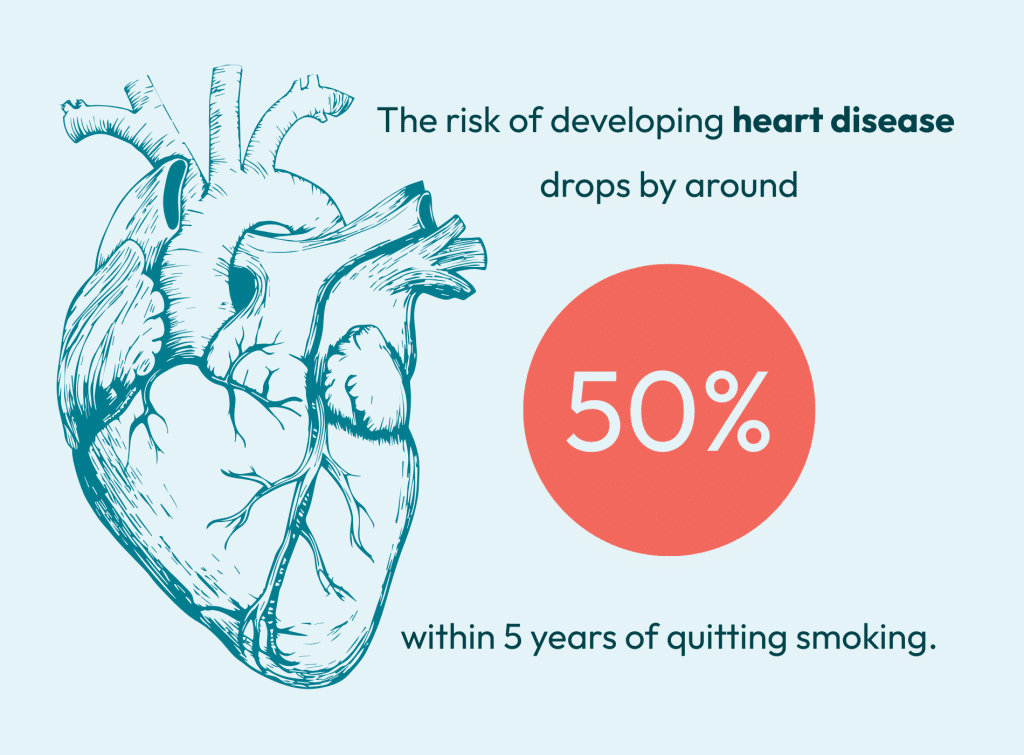
A light blue image with an illustrated anatomical heart on the left. The text reads "The risk of developing heart disease drops by around 50% within 5 years of quitting."

Read the full study here. Global Action is not affiliated with this work.

Global Action ANSWERS YOUR QUESTIONS

What’s the best way to stop smoking?

The best strategy to quit smoking is the one that works for you.

Nicotine replacement therapies are popular aids that reduce withdrawal symptoms by providing controlled, low doses of nicotine without the harmful toxins found in tobacco smoke. Additionally, many people have successfully quit smoking with the help of a doctor who can prescribe cessation medications. Others find that talking to a counselor or joining a support group improves their ability to quit. It’s fairly common for people who smoke to use a combination of these methods, too.

However, these solutions may not work for everyone. For those adults who smoke and can’t or won’t quit, alternative solutions such as nicotine e-cigarettes, heated tobacco products, or nicotine pouches can be solutions to help lower long-term health risks due to smoking. Switching from cigarettes to any one of these alternatives is called tobacco harm reduction.

It’s typical for people to make many quit attempts before finding a strategy that sticks—and that’s okay! The important thing to remember is that every attempt is progress. It’s getting you closer to quitting for good.

Learn more about all the ways you can quit here.

Thank you for your support

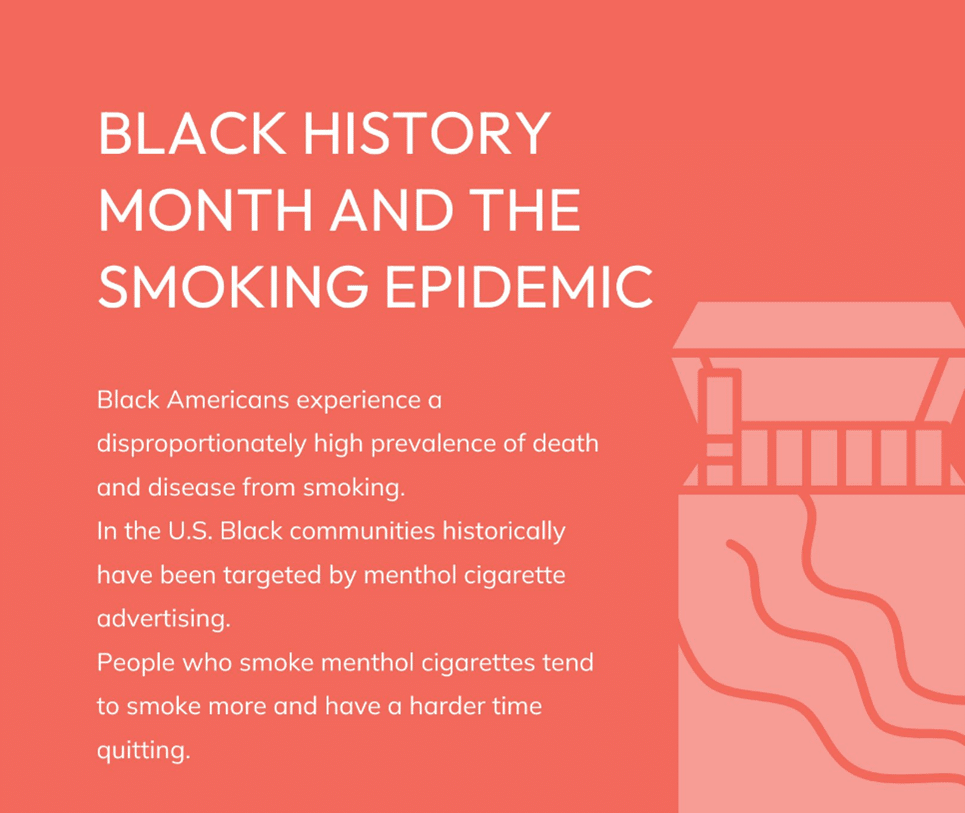
A coral graphic with an image of illustrated cigarettes in the right lower-hand graphic. The text reads "Black History month and the smoking epidemic: Black Americans experience a disproportionately high prevalence of death and disease from smoking. In the U.S. Black communities have historically been targeted by menthol cigarette advertising. People who smoke menthol cigarettes tend to smoke more and have a harder time quitting."

February is Black History Month.

At Global Action to End Smoking we respect all people who smoke and seek creative, evidence-based ways to help them stop smoking and, as needed, move down the continuum of risk.

We are one of the only public health groups to embrace tobacco harm reduction as a means of meeting adults who smoke where they are, showing them empathy in their individual cessation journeys, and helping them—if they cannot or will not quit—to reduce their risks of death or disease from combustible cigarettes.

Your support increases the impact our grantees’ work can have on this cause. Together, we can build a future where no one suffers from tobacco-related disease.

Donate Here

Thank you for your support in the fight against smoking.

Get to Know Global Action

Global Action has awarded more than 175 grants to institutions that support the work of over 100 scientists, covering 46 countries on four continents.

Our organization is an independent, U.S. nonprofit 501(c)(3) grantmaking organization whose mission is to end combustible tobacco use, which remains the leading preventable cause of death globally. Through September 2023, Global Action received charitable gifts from PMI Global Services Inc. Global Action does not seek or accept funding from companies that produce tobacco or non-medicinal nicotine products.

To learn more about our work, visit our website.

Disclaimer: This newsletter does not provide medical advice. The information, including but not limited to, text, graphics, images and other material contained in this newsletter are for informational and educational purposes only and does not constitute providing medical advice or professional services. No material in this newsletter is intended to be a substitute for diagnosing or treating a health problem or disease. Those seeking personal medical advice should consult with a licensed physician or other qualified health care provider. Always seek the advice of your licensed physician or other qualified health care provider regarding a medical condition or with any questions you may have regarding treatment and before undertaking a new health care regimen. Never disregard professional medical advice or delay in seeking it because of something you read in this newsletter. No physician-patient relationship is created by this newsletter. Global Action doesn’t make representations, express or implied, with respect to the information provided here.
Categories
Newsletter

We believe you can quit smoking for good in 2026

Global Action to End Smoking Logo

Global Action Community Newsletter

Guest Contributor: David MacKintosh, Knowledge·Action·Change

Most people know quitting smoking can transform their health. Data from multiple countries and communities consistently shows that many want to give up or reduce combustible tobacco use. Yet quitting is the New Year’s resolution tens of millions don’t keep, year after year.

By now, it’s clear this isn’t a problem of willpower or motivation. Instead, people need better support. While traditional nicotine replacement therapies, pharmaceuticals, and counselling may work for some adults, others may still not be able to quit. In these cases, tobacco harm reduction—or the use of reduced-risk nicotine products—may be helpful.

The good news is that some countries are leading the way in making smoking a relic of the past. In In Sweden, Norway, New Zealand and the United Kingdom, declines in smoking rates have been accelerating, approaching or even falling below the five percent prevalence, which is often the target public health officials aim for when setting goals to eliminate smoking.

In part, some of these declines in smoking are related to restrictions, effective tax regimes, and cessation support for adults who want to quit. But the countries with the most success in lowering smoking rates also have widespread consumer uptake of one or more safer nicotine products.

We can definitely say that tobacco harm reduction is happening. Our next challenge is to ensure that it’s accessible to every adult who needs it.

View the Global State of Tobacco Harm Reduction

GSTHR

Effective public health is built on a solid foundation of evidence, and there’s already plenty of science backing the efficacy of tobacco harm reduction. At Knowledge·Action·Change (KAC), we have been committed to gathering and disseminating this information since 2018, when we created our Global State of Tobacco Harm Reduction project. With support from Global Action, we’ve told the tobacco harm reduction story in landmark biennial reports and regular thematic Briefing Papers in 13 languages.

The Global State of Tobacco Harm Reduction project makes this information available to all, including the people leading public health efforts in low-and middle-income countries, which shoulder a disproportionate amount of the disease and death caused by smoking. We update this project regularly with the newest data about smoking prevalence, associated mortality, and the accessibility of nicotine replacement therapy across 198 countries. We also map the availability, regulatory status and use of less-risky nicotine products, information overlooked by most sources.

In 2026, KAC will continue providing comprehensive, evidence-based information about smoking cessation, including tobacco harm reduction. Tobacco harm reduction offers adults who smoke hope for a life after combustible tobacco. Broader understanding of this fact would be a huge win for global health, helping millions make their new year’s resolution to quit one that sticks.

All my best,

David MacKintosh

Director, Knowledge· Action·Change Programmes

By the Numbers

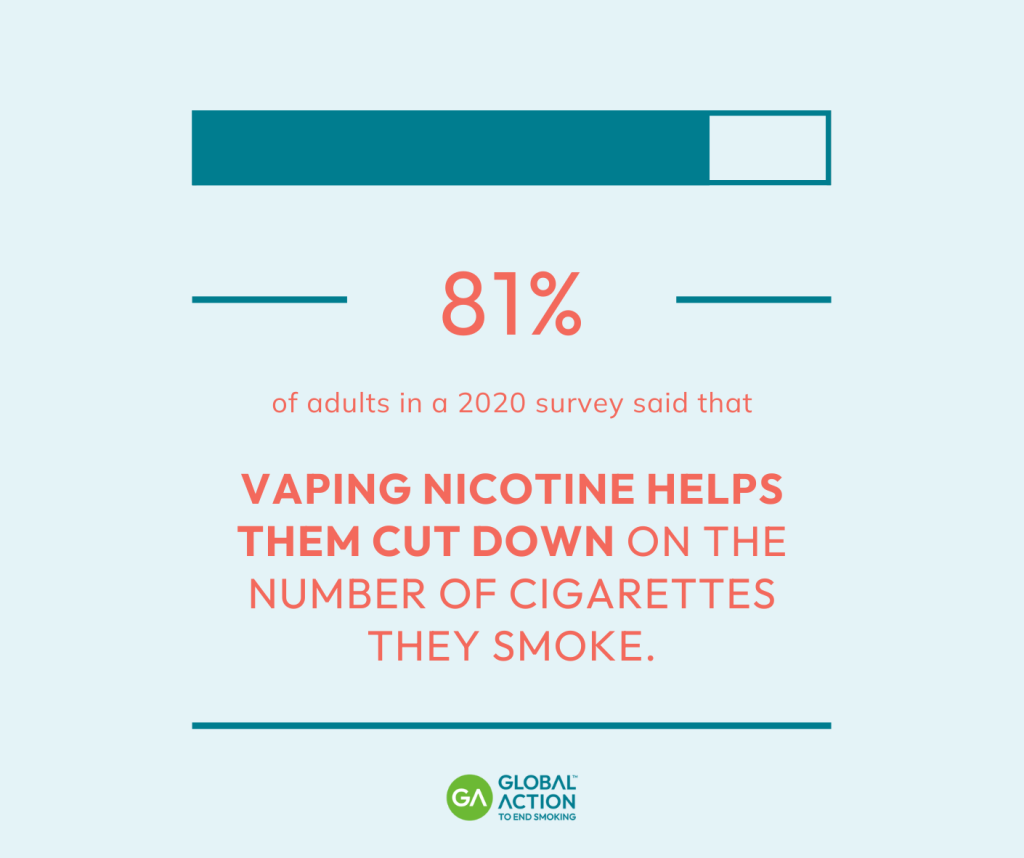
An infographic that reads: "81% of adults in a 2020 survey said that vaping nicotine helps them cut down on the number of cigarettes they smoke."

This survey was conducted in 2020 and included more than 3,000 adults in Australia, Canada, England, and the United States. Read more about the study here. Global Action is not affiliated with this work..

Global Action ANSWERS YOUR QUESTIONS

I want to quit smoking, but I’ve never been able to stop for more than a few weeks at a time. Where should I start over?

It’s clear from your question that you are well on your way to making a lasting change. You are already determined to quit smoking, and through your past attempts to quit you have taken tangible steps in that direction. Congratulations on your progress!

Finding the right combination of tools and support to quit smoking can be a trial-and-error process. During this process, you are likely to experience false starts that feel like failures. But the truth is that each attempt is a chance to learn more about what will or won’t work for you. Each attempt moves you closer to long-term cessation.

With that in mind, it might make sense to decide your next steps by reflecting on your past quit attempts. Ask yourself: What tools and support systems did you use? What proved to be the most helpful to you? When were your cravings the strongest, and what would have helped you in those moments?

There has never been a better time to quit smoking. There are more evidence-based cessation tools, therapies, and alternative nicotine products than there have ever been before. It’s never too late to speak with your primary care provider about all the ways you can quit or join a cessation program for support.

Keep going, and don’t forget to recognize small wins along the way. With each one you are building a healthier future for yourself.

Learn more about all the ways you can quit here.

GET TO KNOW OUR GRANTEES: MOVIMIENTO PRO-VECINO

“If we want to achieve our goals in smoking cessation, we have to really consider the role of alternative products.”

— Fernando Briseño, Principal Investigator, Movimiento Pro-Vecino

Thank you for your support

Give the gift of a healthier tomorrow.

We are taking bold action to find global solutions to end death and disease caused by tobacco, particularly combustible cigarettes. We are one of the only public health groups to embrace tobacco harm reduction as the best viable strategy for ending the global smoking epidemic.

We’re proud to support grantees such as Knowledge Action Change, which recently published this free course on tobacco harm reduction. 

Your support makes this work possible. Together, we can build a future where no one suffers from tobacco-related disease.

Donate Here

Thank you for your support in the fight against smoking.

Get to Know Global Action

Global Action has awarded more than 175 grants to institutions that support the work of over 100 scientists, covering 46 countries on four continents.

Our organization is an independent, U.S. nonprofit 501(c)(3) grantmaking organization whose mission is to end combustible tobacco use, which remains the leading preventable cause of death globally. Through September 2023, Global Action received charitable gifts from PMI Global Services Inc. Global Action does not seek or accept funding from companies that produce tobacco or non-medicinal nicotine products.

To learn more about our work, visit our website.

Disclaimer: This newsletter does not provide medical advice. The information, including but not limited to, text, graphics, images and other material contained in this newsletter are for informational and educational purposes only and does not constitute providing medical advice or professional services. No material in this newsletter is intended to be a substitute for diagnosing or treating a health problem or disease. Those seeking personal medical advice should consult with a licensed physician or other qualified health care provider. Always seek the advice of your licensed physician or other qualified health care provider regarding a medical condition or with any questions you may have regarding treatment and before undertaking a new health care regimen. Never disregard professional medical advice or delay in seeking it because of something you read in this newsletter. No physician-patient relationship is created by this newsletter. Global Action doesn’t make representations, express or implied, with respect to the information provided here.

Categories
Newsletter

The hidden health costs of global conflict

Global Action to End Smoking Logo

Global Action Community Newsletter

Veterans deserve the best smoking cessation support, but that’s not what most receive.

Soldiers give years of their lives to service, which sadly takes a major toll on their mental health. As a result, many wind up picking up smoking—the world’s leading preventable cause of death.

Veterans are around 40% more likely to smoke than the general population. Studies show that during periods of unrest, tobacco use increases across military personnel and the general population alike. It’s often linked to the stress of living in a dangerous environment.

For soldiers enduring constant shelling, blackouts, and battlefield stress, smoking often feels like the only way to cope. In reality, it only deepens anxiety, drains energy, and forms dependence. Quitting smoking under such conditions isn’t just a matter of breaking a habit—it’s a psychological transformation that requires support and the right approach.

I am the head of Healthy Initiatives, a public health organization that reaches out to this population with compassion and the resources required for someone to quit smoking in a high-stress environment. As a grantee of Global Action to End Smoking, we work in nine countries throughout Eastern Europe and Central Asia to train leaders, such as medical providers and military personnel, on the best practices for helping people to move away from cigarettes.

Submit a question on the latest quitting research, and we may answer it in an upcoming newsletter.

CLICK HERE TO SEND US YOUR ANSWER

A view from one of Healthy Initiatives' teaching sessions for local health care providers on tobacco harm reduction.

I am especially proud of our recent attention to Ukraine, where years of full-scale war have undone some of the country’s prior progress toward eliminating smoking. In Ukraine, the number of people who smoke has grown by twenty percent since February 2022. Today, one in three Ukranians smoke, including half of all men. This includes both soldiers and civilians who live in the region. Most of those who smoke do so daily.

At Healthy Initiatives, our programs are based on the science of tobacco harm reduction. If someone who smokes isn’t ready to quit completely, we affirm that reducing harm by switching from combustible cigarettes to vapes, heated tobacco products, or nicotine pouches is a meaningful step toward better health. Our approach is backed by research about harm reduction from the global scientific community as well as our own research specific to smoking cessation in conflict zones.

The conflict in Ukraine presents us with an opportunity to uplift soldiers and veterans of war, to reclaim some of the markers of health that combustible tobacco has taken from them. We can return some of what’s lost through war by helping people who live through it to quit smoking.

All my best,

Nadiya Bedrychuk

Head of Healthy Initiatives

By the Numbers

40%

The increased likelihood of veterans to smoke compared to the general population. Healthy Initiatives is working to address the smoking cessation disparities among this population and others affected by geopolitical conflict.

Global Action ANSWERS YOUR QUESTIONS

What should I do if I quit smoking, but I’ve since slipped up?

First and foremost, congratulations on quitting! It’s a huge accomplishment and major step in reducing your risk of disease and death in the long run. You should be proud.

Second, rest assured that a slip-up, or returning to smoking, is a common part of many people’s journeys to quit. It’s a temporary set back, but it doesn’t have to be the end of your story.

The time you spent abstaining from smoking is not a waste. You learned about your relationship to smoking and what works best for you to stop—whether it’s support from loved ones, health care providers, nicotine replacement therapies, or reduced-risk nicotine products like e-cigarettes, heated tobacco products, or nicotine pouches.

The fact that you returned to cigarettes after a period of cessation does not mean you failed. Rather, it is a learning opportunity for you to understand what circumstances led you back to smoking. Perhaps you were in a social situation where others were smoking. Perhaps it was a particularly stressful day.

Whatever the situation, you’re likely to encounter it again. Next time, you can be better prepared. Maybe this means ensuring that you’re prepared with a buddy who will also decline a cigarette in a social situation, or that you’re carrying additional nicotine replacement therapies or reduced-risk nicotine products to help you make it through a tough craving.

Don’t worry about the past—it’s behind you! There’s no better day than today to try again to live a longer, healthier life.

Learn more about all the ways you can quit here.

Thank you for your support

Give the gift of a healthier tomorrow.

We are taking bold action to find global solutions to end death and disease caused by tobacco, particularly combustible cigarettes. We are one of the only public health groups to embrace tobacco harm reduction as the best viable strategy for ending the global smoking epidemic.

We’re proud to support grantees such as Knowledge Action Change, which recently published this free course on tobacco harm reduction. 

Your support makes this work possible. Together, we can build a future where no one suffers from tobacco-related disease.

Donate Here

Thank you for your support in the fight against smoking.

Get to Know Global Action

Global Action has awarded more than 175 grants to institutions that support the work of over 100 scientists, covering 46 countries on four continents.

Our organization is an independent, U.S. nonprofit 501(c)(3) grantmaking organization whose mission is to end combustible tobacco use, which remains the leading preventable cause of death globally. Through September 2023, Global Action received charitable gifts from PMI Global Services Inc. Global Action does not seek or accept funding from companies that produce tobacco or non-medicinal nicotine products.

To learn more about our work, visit our website.

Disclaimer: This newsletter does not provide medical advice. The information, including but not limited to, text, graphics, images and other material contained in this newsletter are for informational and educational purposes only and does not constitute providing medical advice or professional services. No material in this newsletter is intended to be a substitute for diagnosing or treating a health problem or disease. Those seeking personal medical advice should consult with a licensed physician or other qualified health care provider. Always seek the advice of your licensed physician or other qualified health care provider regarding a medical condition or with any questions you may have regarding treatment and before undertaking a new health care regimen. Never disregard professional medical advice or delay in seeking it because of something you read in this newsletter. No physician-patient relationship is created by this newsletter. Global Action doesn’t make representations, express or implied, with respect to the information provided here.

Categories
Newsletter

We’re fighting tobacco dependence at all levels

Global Action to End Smoking Logo

Global Action Community Newsletter

We’re dedicated to ending the global smoking epidemic—the leading cause of preventable death—by focusing on overlooked populations.

We center people who smoke in our conversations because often they’re left out of bigger public health discussions. But tobacco impacts more than global health. For many, it makes up their livelihoods.

We recognize that as demand for cigarettes decreases, smallholder farmers who produce tobacco crops may suffer economically. In Malawi, a country in Africa, tobacco represents a significant portion of the country’s gross domestic product and roughly half of its exports.

Through the work of our affiliate, the Agricultural Transformation Initiative, and many of our grantees, we took action to empower these farmers at the local and national levels to diversify their crops to make them economically and environmentally sustainable.

This month, I had the pleasure of leading the ribbon-cutting ceremony of the Global Action Agricultural Transformation Centre in Malawi—a state-of-the-art facility complete with labs for soil and food analysis, collaborative meeting spaces for peer-to-peer learning, and lecture rooms to disseminate new findings in agricultural best practices. We formally gifted the GA Centre to the Lilongwe University of Agriculture and Natural Resources, which was a natural choice to ensure our legacy carries on for years to come.

But research shows that the opposite is true: When older people try to quit, they often succeed. A large study of people over 55 years old in the U.S. found that more than half of those alive at the end of the 20-year study period had successfully quit smoking for at least 2 years. Another study found that even older adults with a low motivation to quit did so successfully more than twice as often as younger adults with low motivation to quit.

It is imperative that we support older adults who smoke—especially those who come from places where smoking is common. Estimates suggest that by 2050, more than 70% of the world’s dementia cases will occur in people who live in low- and middle-income countries. These countries also have the highest rates of smoking. In order to ease the potential burden of dementia, we must support individuals in these spaces to quit using any means possible, whether with traditional nicotine replacement therapies or by switching to reduced-risk nicotine products.

It’s never too late for someone to stop smoking. Even if a person has started to experience health problems from smoking, there are often benefits to quitting, such as better response to treatments, being more likely to recover, and improved quality of life. We have an opportunity to reach out to this group with cessation support, which could potentially add years to their lives shared with loved ones.

From left to right: Dr. Cori Lathan, Global Action board member; Dr. Candida Nakhumwa, Vice President and Country Director for Global Action in Malawi; and Pamela Parizek, Executive Board Chair of Global Action.

Even before the GA Centre’s completion, our grantees developed programs and initiatives to foster new education in agricultural best practices. Already, we’ve directly impacted more than 100,000 smallholder farmers and indirectly supported more than 800,000. Many of these farmers already have reported increased yields and incomes as they switched to crops such as soybeans, groundnuts, bananas, and sunflowers.

Our grantees also have been hard at work beyond the Centre. For example, a team at Michigan State University led the development of the Malawi Agricultural Policy Advancement and Transformation Agenda, a think tank that works closely with the Malawian government to develop evolving policies to support agricultural transformation. Additionally, we’ve supported scholarships for master’s and PhD students to learn more about both agriculture and business, many of whom have become entrepreneurs in this space.

The GA Centre is just one example of how we are ensuring no one gets left behind as we work together to end smoking.

All my best,

Pamela Parizek

Executive Board Chair

Global Action to End Smoking

By the numbers

global action answers your questions

How can I quit smoking when I’ve been doing it for more than a decade?

As a place to start, rather than looking at quitting as one big goal, it may be better to break it down into several smaller parts.

Our bodies can become used to the stimulant nicotine, which is found in tobacco. But also, our minds can develop an association with smoking with certain situations, like being stressed or socializing. Thinking about when and where you smoke most often can help you come up with strategies that help you tackle each situation.

One strategy to overcome the physical addiction to nicotine is to replace the nicotine in cigarettes with nicotine in less-risky products. These products include nicotine replacement therapies, like nicotine gum or patches. However, if these don’t work for you, you can also consider reduced-risk nicotine products, like authorized e-cigarettes or nicotine pouches. These products will all deliver the nicotine your body craves without many of the dangerous chemicals found in combustible cigarettes.

Very few people wake up one day and just stop. For most of us, it is a process.  The key to becoming a non-smoker is to keep trying, even if you experience a setback.

Learn more about all the ways you can quit here

get to know our grantees

Thank you for your support

Donate Here

Global Action is proud to take bold action to find global solutions to end death and disease caused by tobacco, particularly combustible cigarettes. We are one of the only public health groups to embrace tobacco harm reduction as a means of meeting adults who smoke where they are, showing them empathy and respect in their individual cessation journeys, and helping them—if they cannot or will not quit—to reduce their risks of death or disease from combustible cigarettes.

Your support increases the impact our grantees’ work can have on this cause. Together, we can build a future where no one suffers from tobacco-related disease.

Thank you for your support in the fight against smoking.

Get to Know Global Action

Global Action has awarded more than 175 grants to institutions that support the work of over 100 scientists, covering 46 countries on four continents.

Our organization is an independent, U.S. nonprofit 501(c)(3) grantmaking organization whose mission is to end combustible tobacco use, which remains the leading preventable cause of death globally. Through September 2023, Global Action received charitable gifts from PMI Global Services Inc. Global Action does not seek or accept funding from companies that produce tobacco or non-medicinal nicotine products.

To learn more about our work, visit our website.

Disclaimer: This newsletter does not provide medical advice. The information, including but not limited to, text, graphics, images and other material contained in this newsletter are for informational and educational purposes only and does not constitute providing medical advice or professional services. No material in this newsletter is intended to be a substitute for diagnosing or treating a health problem or disease. Those seeking personal medical advice should consult with a licensed physician or other qualified health care provider. Always seek the advice of your licensed physician or other qualified health care provider regarding a medical condition or with any questions you may have regarding treatment and before undertaking a new health care regimen. Never disregard professional medical advice or delay in seeking it because of something you read in this newsletter. No physician-patient relationship is created by this newsletter. Global Action doesn’t make representations, express or implied, with respect to the information provided here.