Categories
Newsletter

We believe you can quit smoking for good in 2026

Global Action to End Smoking Logo

Global Action Community Newsletter

Guest Contributor: David MacKintosh, Knowledge·Action·Change

Most people know quitting smoking can transform their health. Data from multiple countries and communities consistently shows that many want to give up or reduce combustible tobacco use. Yet quitting is the New Year’s resolution tens of millions don’t keep, year after year.

By now, it’s clear this isn’t a problem of willpower or motivation. Instead, people need better support. While traditional nicotine replacement therapies, pharmaceuticals, and counselling may work for some adults, others may still not be able to quit. In these cases, tobacco harm reduction—or the use of reduced-risk nicotine products—may be helpful.

The good news is that some countries are leading the way in making smoking a relic of the past. In In SwedenNorwayNew Zealand and the United Kingdom, declines in smoking rates have been accelerating, approaching or even falling below the five percent prevalence, which is often the target public health officials aim for when setting goals to eliminate smoking.

In part, some of these declines in smoking are related to restrictions, effective tax regimes, and cessation support for adults who want to quit. But the countries with the most success in lowering smoking rates also have widespread consumer uptake of one or more safer nicotine products.

We can definitely say that tobacco harm reduction is happening. Our next challenge is to ensure that it’s accessible to every adult who needs it.

View the Global State of Tobacco Harm Reduction

GSTHR

Effective public health is built on a solid foundation of evidence, and there’s already plenty of science backing the efficacy of tobacco harm reduction. At Knowledge·Action·Change (KAC), we have been committed to gathering and disseminating this information since 2018, when we created our Global State of Tobacco Harm Reduction project. With support from Global Action, we’ve told the tobacco harm reduction story in landmark biennial reports and regular thematic Briefing Papers in 13 languages.

The Global State of Tobacco Harm Reduction project makes this information available to all, including the people leading public health efforts in low-and middle-income countries, which shoulder a disproportionate amount of the disease and death caused by smoking. We update this project regularly with the newest data about smoking prevalence, associated mortality, and the accessibility of nicotine replacement therapy across 198 countries. We also map the availability, regulatory status and use of less-risky nicotine products, information overlooked by most sources.

In 2026, KAC will continue providing comprehensive, evidence-based information about smoking cessation, including tobacco harm reduction. Tobacco harm reduction offers adults who smoke hope for a life after combustible tobacco. Broader understanding of this fact would be a huge win for global health, helping millions make their new year’s resolution to quit one that sticks.

All my best,
David MacKintosh

Director, Knowledge· Action·Change Programmes

By the Numbers
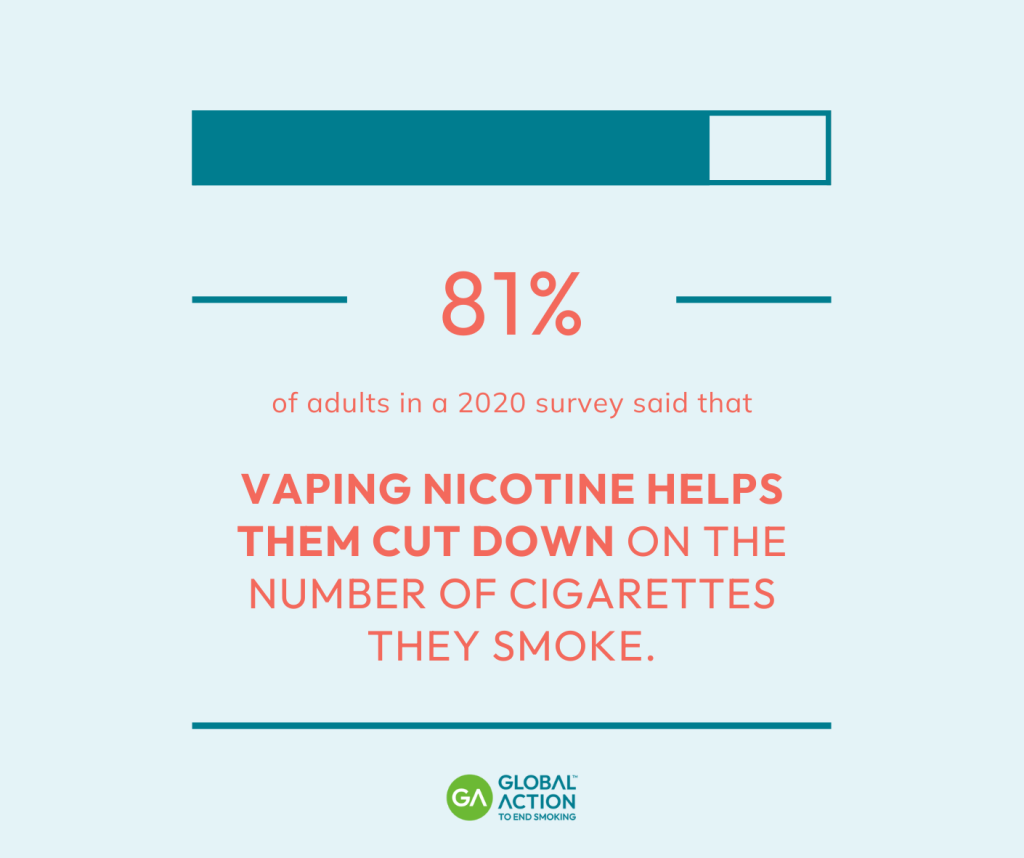
An infographic that reads: "81% of adults in a 2020 survey said that vaping nicotine helps them cut down on the number of cigarettes they smoke."

This survey was conducted in 2020 and included more than 3,000 adults in Australia, Canada, England, and the United States. Read more about the study here. Global Action is not affiliated with this work..

Global Action ANSWERS YOUR QUESTIONS

I want to quit smoking, but I’ve never been able to stop for more than a few weeks at a time. Where should I start over?

It’s clear from your question that you are well on your way to making a lasting change. You are already determined to quit smoking, and through your past attempts to quit you have taken tangible steps in that direction. Congratulations on your progress!

Finding the right combination of tools and support to quit smoking can be a trial-and-error process. During this process, you are likely to experience false starts that feel like failures. But the truth is that each attempt is a chance to learn more about what will or won’t work for you. Each attempt moves you closer to long-term cessation.

With that in mind, it might make sense to decide your next steps by reflecting on your past quit attempts. Ask yourself: What tools and support systems did you use? What proved to be the most helpful to you? When were your cravings the strongest, and what would have helped you in those moments?

There has never been a better time to quit smoking. There are more evidence-based cessation tools, therapies, and alternative nicotine products than there have ever been before. It’s never too late to speak with your primary care provider about all the ways you can quit or join a cessation program for support.

Keep going, and don’t forget to recognize small wins along the way. With each one you are building a healthier future for yourself.

Learn more about all the ways you can quit here.

GET TO KNOW OUR GRANTEES: MOVIMIENTO PRO-VECINO

“If we want to achieve our goals in smoking cessation, we have to really consider the role of alternative products.”

— Fernando Briseño, Principal Investigator, Movimiento Pro-Vecino

Thank you for your support
Give the gift of a healthier tomorrow.

We are taking bold action to find global solutions to end death and disease caused by tobacco, particularly combustible cigarettes. We are one of the only public health groups to embrace tobacco harm reduction as the best viable strategy for ending the global smoking epidemic.

We’re proud to support grantees such as Knowledge Action Change, which recently published this free course on tobacco harm reduction. 

Your support makes this work possible. Together, we can build a future where no one suffers from tobacco-related disease.

Donate Here

Thank you for your support in the fight against smoking.

Get to Know Global Action

Global Action has awarded more than 175 grants to institutions that support the work of over 100 scientists, covering 46 countries on four continents.

Our organization is an independent, U.S. nonprofit 501(c)(3) grantmaking organization whose mission is to end combustible tobacco use, which remains the leading preventable cause of death globally. Through September 2023, Global Action received charitable gifts from PMI Global Services Inc. Global Action does not seek or accept funding from companies that produce tobacco or non-medicinal nicotine products.

To learn more about our work, visit our website.

Disclaimer: This newsletter does not provide medical advice. The information, including but not limited to, text, graphics, images and other material contained in this newsletter are for informational and educational purposes only and does not constitute providing medical advice or professional services. No material in this newsletter is intended to be a substitute for diagnosing or treating a health problem or disease. Those seeking personal medical advice should consult with a licensed physician or other qualified health care provider. Always seek the advice of your licensed physician or other qualified health care provider regarding a medical condition or with any questions you may have regarding treatment and before undertaking a new health care regimen. Never disregard professional medical advice or delay in seeking it because of something you read in this newsletter. No physician-patient relationship is created by this newsletter. Global Action doesn’t make representations, express or implied, with respect to the information provided here.


Categories
Newsletter

The hidden health costs of global conflict

Global Action to End Smoking Logo

Global Action Community Newsletter

Veterans deserve the best smoking cessation support, but that’s not what most receive.

Soldiers give years of their lives to service, which sadly takes a major toll on their mental health. As a result, many wind up picking up smoking—the world’s leading preventable cause of death.

Veterans are around 40% more likely to smoke than the general population. Studies show that during periods of unrest, tobacco use increases across military personnel and the general population alike. It’s often linked to the stress of living in a dangerous environment.

For soldiers enduring constant shelling, blackouts, and battlefield stress, smoking often feels like the only way to cope. In reality, it only deepens anxiety, drains energy, and forms dependence. Quitting smoking under such conditions isn’t just a matter of breaking a habit—it’s a psychological transformation that requires support and the right approach.

I am the head of Healthy Initiatives, a public health organization that reaches out to this population with compassion and the resources required for someone to quit smoking in a high-stress environment. As a grantee of Global Action to End Smoking, we work in nine countries throughout Eastern Europe and Central Asia to train leaders, such as medical providers and military personnel, on the best practices for helping people to move away from cigarettes.

Submit a question on the latest quitting research, and we may answer it in an upcoming newsletter.

CLICK HERE TO SEND US YOUR ANSWER

A view from one of Healthy Initiatives' teaching sessions for local health care providers on tobacco harm reduction.

I am especially proud of our recent attention to Ukraine, where years of full-scale war have undone some of the country’s prior progress toward eliminating smoking. In Ukraine, the number of people who smoke has grown by twenty percent since February 2022. Today, one in three Ukranians smoke, including half of all men. This includes both soldiers and civilians who live in the region. Most of those who smoke do so daily.

At Healthy Initiatives, our programs are based on the science of tobacco harm reduction. If someone who smokes isn’t ready to quit completely, we affirm that reducing harm by switching from combustible cigarettes to vapes, heated tobacco products, or nicotine pouches is a meaningful step toward better health. Our approach is backed by research about harm reduction from the global scientific community as well as our own research specific to smoking cessation in conflict zones.

The conflict in Ukraine presents us with an opportunity to uplift soldiers and veterans of war, to reclaim some of the markers of health that combustible tobacco has taken from them. We can return some of what’s lost through war by helping people who live through it to quit smoking.

All my best,

Nadiya Bedrychuk

Head of Healthy Initiatives

By the Numbers

40%

The increased likelihood of veterans to smoke compared to the general population. Healthy Initiatives is working to address the smoking cessation disparities among this population and others affected by geopolitical conflict.

Global Action ANSWERS YOUR QUESTIONS

What should I do if I quit smoking, but I’ve since slipped up?

First and foremost, congratulations on quitting! It’s a huge accomplishment and major step in reducing your risk of disease and death in the long run. You should be proud.

Second, rest assured that a slip-up, or returning to smoking, is a common part of many people’s journeys to quit. It’s a temporary set back, but it doesn’t have to be the end of your story.

The time you spent abstaining from smoking is not a waste. You learned about your relationship to smoking and what works best for you to stop—whether it’s support from loved ones, health care providers, nicotine replacement therapies, or reduced-risk nicotine products like e-cigarettes, heated tobacco products, or nicotine pouches.

The fact that you returned to cigarettes after a period of cessation does not mean you failed. Rather, it is a learning opportunity for you to understand what circumstances led you back to smoking. Perhaps you were in a social situation where others were smoking. Perhaps it was a particularly stressful day.

Whatever the situation, you’re likely to encounter it again. Next time, you can be better prepared. Maybe this means ensuring that you’re prepared with a buddy who will also decline a cigarette in a social situation, or that you’re carrying additional nicotine replacement therapies or reduced-risk nicotine products to help you make it through a tough craving.

Don’t worry about the past—it’s behind you! There’s no better day than today to try again to live a longer, healthier life.

Learn more about all the ways you can quit here.

Thank you for your support

Give the gift of a healthier tomorrow.

We are taking bold action to find global solutions to end death and disease caused by tobacco, particularly combustible cigarettes. We are one of the only public health groups to embrace tobacco harm reduction as the best viable strategy for ending the global smoking epidemic.

We’re proud to support grantees such as Knowledge Action Change, which recently published this free course on tobacco harm reduction. 

Your support makes this work possible. Together, we can build a future where no one suffers from tobacco-related disease.

Donate Here

Thank you for your support in the fight against smoking.

Get to Know Global Action

Global Action has awarded more than 175 grants to institutions that support the work of over 100 scientists, covering 46 countries on four continents.

Our organization is an independent, U.S. nonprofit 501(c)(3) grantmaking organization whose mission is to end combustible tobacco use, which remains the leading preventable cause of death globally. Through September 2023, Global Action received charitable gifts from PMI Global Services Inc. Global Action does not seek or accept funding from companies that produce tobacco or non-medicinal nicotine products.

To learn more about our work, visit our website.

Disclaimer: This newsletter does not provide medical advice. The information, including but not limited to, text, graphics, images and other material contained in this newsletter are for informational and educational purposes only and does not constitute providing medical advice or professional services. No material in this newsletter is intended to be a substitute for diagnosing or treating a health problem or disease. Those seeking personal medical advice should consult with a licensed physician or other qualified health care provider. Always seek the advice of your licensed physician or other qualified health care provider regarding a medical condition or with any questions you may have regarding treatment and before undertaking a new health care regimen. Never disregard professional medical advice or delay in seeking it because of something you read in this newsletter. No physician-patient relationship is created by this newsletter. Global Action doesn’t make representations, express or implied, with respect to the information provided here.

Categories
Newsletter

We’re fighting tobacco dependence at all levels

Global Action to End Smoking Logo

Global Action Community Newsletter

We’re dedicated to ending the global smoking epidemic—the leading cause of preventable death—by focusing on overlooked populations.

We center people who smoke in our conversations because often they’re left out of bigger public health discussions. But tobacco impacts more than global health. For many, it makes up their livelihoods.

We recognize that as demand for cigarettes decreases, smallholder farmers who produce tobacco crops may suffer economically. In Malawi, a country in Africa, tobacco represents a significant portion of the country’s gross domestic product and roughly half of its exports.

Through the work of our affiliate, the Agricultural Transformation Initiative, and many of our grantees, we took action to empower these farmers at the local and national levels to diversify their crops to make them economically and environmentally sustainable.

This month, I had the pleasure of leading the ribbon-cutting ceremony of the Global Action Agricultural Transformation Centre in Malawi—a state-of-the-art facility complete with labs for soil and food analysis, collaborative meeting spaces for peer-to-peer learning, and lecture rooms to disseminate new findings in agricultural best practices. We formally gifted the GA Centre to the Lilongwe University of Agriculture and Natural Resources, which was a natural choice to ensure our legacy carries on for years to come.

But research shows that the opposite is true: When older people try to quit, they often succeed. A large study of people over 55 years old in the U.S. found that more than half of those alive at the end of the 20-year study period had successfully quit smoking for at least 2 years. Another study found that even older adults with a low motivation to quit did so successfully more than twice as often as younger adults with low motivation to quit.

It is imperative that we support older adults who smoke—especially those who come from places where smoking is common. Estimates suggest that by 2050, more than 70% of the world’s dementia cases will occur in people who live in low- and middle-income countries. These countries also have the highest rates of smoking. In order to ease the potential burden of dementia, we must support individuals in these spaces to quit using any means possible, whether with traditional nicotine replacement therapies or by switching to reduced-risk nicotine products.

It’s never too late for someone to stop smoking. Even if a person has started to experience health problems from smoking, there are often benefits to quitting, such as better response to treatments, being more likely to recover, and improved quality of life. We have an opportunity to reach out to this group with cessation support, which could potentially add years to their lives shared with loved ones.

From left to right: Dr. Cori Lathan, Global Action board member; Dr. Candida Nakhumwa, Vice President and Country Director for Global Action in Malawi; and Pamela Parizek, Executive Board Chair of Global Action.

Even before the GA Centre’s completion, our grantees developed programs and initiatives to foster new education in agricultural best practices. Already, we’ve directly impacted more than 100,000 smallholder farmers and indirectly supported more than 800,000. Many of these farmers already have reported increased yields and incomes as they switched to crops such as soybeans, groundnuts, bananas, and sunflowers.

Our grantees also have been hard at work beyond the Centre. For example, a team at Michigan State University led the development of the Malawi Agricultural Policy Advancement and Transformation Agenda, a think tank that works closely with the Malawian government to develop evolving policies to support agricultural transformation. Additionally, we’ve supported scholarships for master’s and PhD students to learn more about both agriculture and business, many of whom have become entrepreneurs in this space.

The GA Centre is just one example of how we are ensuring no one gets left behind as we work together to end smoking.

All my best,

Pamela Parizek

Executive Board Chair

Global Action to End Smoking

By the numbers

global action answers your questions

How can I quit smoking when I’ve been doing it for more than a decade?

As a place to start, rather than looking at quitting as one big goal, it may be better to break it down into several smaller parts.

Our bodies can become used to the stimulant nicotine, which is found in tobacco. But also, our minds can develop an association with smoking with certain situations, like being stressed or socializing. Thinking about when and where you smoke most often can help you come up with strategies that help you tackle each situation.

One strategy to overcome the physical addiction to nicotine is to replace the nicotine in cigarettes with nicotine in less-risky products. These products include nicotine replacement therapies, like nicotine gum or patches. However, if these don’t work for you, you can also consider reduced-risk nicotine products, like authorized e-cigarettes or nicotine pouches. These products will all deliver the nicotine your body craves without many of the dangerous chemicals found in combustible cigarettes.

Very few people wake up one day and just stop. For most of us, it is a process.  The key to becoming a non-smoker is to keep trying, even if you experience a setback.

Learn more about all the ways you can quit here

get to know our grantees

Thank you for your support

Donate Here

Global Action is proud to take bold action to find global solutions to end death and disease caused by tobacco, particularly combustible cigarettes. We are one of the only public health groups to embrace tobacco harm reduction as a means of meeting adults who smoke where they are, showing them empathy and respect in their individual cessation journeys, and helping them—if they cannot or will not quit—to reduce their risks of death or disease from combustible cigarettes.

Your support increases the impact our grantees’ work can have on this cause. Together, we can build a future where no one suffers from tobacco-related disease.

Thank you for your support in the fight against smoking.

Get to Know Global Action

Global Action has awarded more than 175 grants to institutions that support the work of over 100 scientists, covering 46 countries on four continents.

Our organization is an independent, U.S. nonprofit 501(c)(3) grantmaking organization whose mission is to end combustible tobacco use, which remains the leading preventable cause of death globally. Through September 2023, Global Action received charitable gifts from PMI Global Services Inc. Global Action does not seek or accept funding from companies that produce tobacco or non-medicinal nicotine products.

To learn more about our work, visit our website.

Disclaimer: This newsletter does not provide medical advice. The information, including but not limited to, text, graphics, images and other material contained in this newsletter are for informational and educational purposes only and does not constitute providing medical advice or professional services. No material in this newsletter is intended to be a substitute for diagnosing or treating a health problem or disease. Those seeking personal medical advice should consult with a licensed physician or other qualified health care provider. Always seek the advice of your licensed physician or other qualified health care provider regarding a medical condition or with any questions you may have regarding treatment and before undertaking a new health care regimen. Never disregard professional medical advice or delay in seeking it because of something you read in this newsletter. No physician-patient relationship is created by this newsletter. Global Action doesn’t make representations, express or implied, with respect to the information provided here.

Categories
Newsletter

Quitting smoking has no age limit

Global Action to End Smoking Logo

Global Action Community Newsletter

In many countries, older adults have the highest smoking rates. Yet they’re often overlooked in smoking cessation efforts.

In the U.S., for example, 15% of adults between ages 45 and 64 smoke—the largest percentage of any other age demographic in the country. The second-highest rate of smoking is among those 65 and older at roughly 9%. However, these individuals make up most of smoking-related deaths, likely due to years of combustible tobacco use.

Older adults who smoke stand to gain a lot by stopping. After quitting, people over 55 can enjoy a lower heart rate and blood pressure, easier breathing, and more success in managing conditions such as diabetes. One study found that older adults who quit on average enjoyed an increased life expectancy of about two to three years—that’s a lot of life to live.

The benefits of quitting smoking extend into neurological health, too. Consider Alzheimer’s disease, the most common form of dementia. Age is a major risk factor for developing Alzheimer’s and other dementias—but another major factor is smoking. Smoking damages the body’s vascular system, which in turn increases the risk of stroke, a major risk factor for dementia. Quitting smoking, therefore, may reduce the risk of developing dementia.

Despite these clear health benefits, older people are often left out of conversations about ending the smoking epidemic. Providers avoid broaching the topic with their older patients because they feel uninformed about smoking cessation in this population, or they don’t fully grasp the potential benefits of quitting for someone who has smoked for several decades. Some providers assume that older people are more likely to fail at attempts to quit, or that they simply can’t or won’t try.

Submit a question on the latest quitting research, and we may answer it in an upcoming newsletter.

CLICK HERE TO SEND US YOUR ANSWER

But research shows that the opposite is true: When older people try to quit, they often succeed. A large study of people over 55 years old in the U.S. found that more than half of those alive at the end of the 20-year study period had successfully quit smoking for at least 2 years. Another study found that even older adults with a low motivation to quit did so successfully more than twice as often as younger adults with low motivation to quit.

It is imperative that we support older adults who smoke—especially those who come from places where smoking is common. Estimates suggest that by 2050, more than 70% of the world’s dementia cases will occur in people who live in low- and middle-income countries. These countries also have the highest rates of smoking. In order to ease the potential burden of dementia, we must support individuals in these spaces to quit using any means possible, whether with traditional nicotine replacement therapies or by switching to reduced-risk nicotine products.

It’s never too late for someone to stop smoking. Even if a person has started to experience health problems from smoking, there are often benefits to quitting, such as better response to treatments, being more likely to recover, and improved quality of life. We have an opportunity to reach out to this group with cessation support, which could potentially add years to their lives shared with loved ones.

All my best,

Dr. Ehsan Latif, M.S.

Senior VP of Grants Management and Health and Science Strategy

Global Action to End Smoking

Did you know?

Get the facts

Although nicotine is the addictive substance in cigarettes, there are other factors that make it hard to quit. For example, many people feel smoking helps them manage their emotions and stress – which can make it harder to quit.

Nicotine withdrawal can be a stressor. Once the body becomes accumulated to regular doses of nicotine, withdrawal can lead to anxiety and agitation. But also, many people who smoke connect tobacco to certain habits—like smoking in certain settings, with certain people, or when they’re doing certain activities like drinking alcohol or coffee.

When a person who smokes is feeling strong negative emotions, the rituals tied to cigarette use can produce a sense of relief that serves as a distraction from unpleasant feelings, including stress. Unfortunately, this relief is often short-lived.

Fortunately, studies have found that most people who quit successfully either have no additional stress or decreased stress levels in their lives. There are so many ways to quit—including counseling, medications, nicotine replacement therapies, and reduced-risk nicotine products.  ways you can quit here.

Tobacco and health around the world

Country snapshot: Argentina

In 2022, an estimated 8.2 million people aged 15 years and older were tobacco users in Argentina. This positions the country as 24th globally and the 4th in the WHO Region of the Americas in terms of number of tobacco users.

  •   Argentina is the 10th largest global producer of unmanufactured tobacco with 95.6 thousand tons, representing approximately 1.7% of the worldwide production of 5.8 million tons.
  •   Demand for cigarettes decreased by 34.3% from 51.5 packs per capita in 2010 to 34 packs per capita in 2022.
  •   In 2021, it was estimated that tobacco was the 2nd highest risk factor driving the most deaths and disability combined in Argentina.

For references and to view other country profiles, visit our pages on Tobacco and Health Around the World.

Thank you for your support

Donate Here

Global Action is proud to take bold action to find global solutions to end death and disease caused by tobacco, particularly combustible cigarettes. We are one of the only public health groups to embrace tobacco harm reduction as a means of meeting adults who smoke where they are, showing them empathy and respect in their individual cessation journeys, and helping them—if they cannot or will not quit—to reduce their risks of death or disease from combustible cigarettes.

Your support increases the impact our grantees’ work can have on this cause. Together, we can build a future where no one suffers from tobacco-related disease.

Thank you for your support in the fight against smoking.

Get to Know Global Action

Global Action has awarded more than 175 grants to institutions that support the work of over 100 scientists, covering 46 countries on four continents.

Our organization is an independent, U.S. nonprofit 501(c)(3) grantmaking organization whose mission is to end combustible tobacco use, which remains the leading preventable cause of death globally. Through September 2023, Global Action received charitable gifts from PMI Global Services Inc. Global Action does not seek or accept funding from companies that produce tobacco or non-medicinal nicotine products.

To learn more about our work, visit our website.

Disclaimer: This newsletter does not provide medical advice. The information, including but not limited to, text, graphics, images and other material contained in this newsletter are for informational and educational purposes only and does not constitute providing medical advice or professional services. No material in this newsletter is intended to be a substitute for diagnosing or treating a health problem or disease. Those seeking personal medical advice should consult with a licensed physician or other qualified health care provider. Always seek the advice of your licensed physician or other qualified health care provider regarding a medical condition or with any questions you may have regarding treatment and before undertaking a new health care regimen. Never disregard professional medical advice or delay in seeking it because of something you read in this newsletter. No physician-patient relationship is created by this newsletter. Global Action doesn’t make representations, express or implied, with respect to the information provided here.
Categories
Newsletter

Tobacco harm reduction is already saving lives

Global Action to End Smoking Logo

Global Action Community Newsletter

One Nordic country has led the way in using tobacco harm reduction to save lives.

In the last few decades, Sweden has been a trailblazer in creating policies that encourage adults to quit smoking and dissuade those who have never smoked from picking up cigarettes.

Sweden was one of the first countries to enforce smoke-free workplaces in 1993. Five years later, the country launched a national helpline for people trying to quit; it even promoted the number on cigarette packs which also included information about the dangers of smoking.

Since then, Sweden has supported the use of snus and other alternative tobacco and nicotine as a way for people who smoke to quit. Snus is a smokeless tobacco product made through a process that removes most of the harmful chemicals found in cigarettes and other forms of non-combustible tobacco. Other forms of reduced-risk nicotine products like nicotine pouches—which contain no tobacco—have also become available in Sweden, as have e-cigarettes.

This is tobacco harm reduction at work. Since 2004, the number of adults who smoke daily in Sweden has fallen from more than 16 percent of the population to around 5 percent. More importantly, key metrics of the country’s public health have improved too: Sweden has among the lowest rates of lung cancer in Europe—of which smoking is a leading cause. By creating an environment where more adults can access alternative nicotine products, Swedish policy is saving lives.

Submit a question on the latest quitting research, and we may answer it in an upcoming newsletter.

CLICK HERE TO SEND US YOUR ANSWER

Another example of tobacco harm reduction at work is the United Kingdom, where public health officials have strongly supported the use of reduced-risk tobacco and nicotine products in cases where individuals cannot or will not quit smoking.

In 2023 the government began offering people who smoke nicotine e-cigarette starter kits paired with behavioral support as part of the national smoking cessation program. The decision to do this was based on research that demonstrated the large reductions in exposure to the dangerous chemicals in cigarettes, and that e-cigarettes have been shown to be an effective tool to help smokers quit.

We know that tobacco harm reduction saves lives, and now we have seen how this strategy can scale to the national level. It is important to highlight these successes and support efforts in more countries to build national programs based on the evidence and compassionate consideration of the needs of people who smoke.

Global Action’s 38 grantees across 41 countries are conducting research that illuminates the many smoking cessation tools available around the world and supporting programs to educate adults who smoke, providers, and other key experts about the public health benefits of tobacco harm reduction. This work complements traditional smoking cessation programs for adults who cannot or otherwise will not quit.

Working together, we can move faster toward a world without the death and disease caused by smoking.

All my best,

Erik Augustson, PhD, MPH, FSBAM

VP of Programs

Global Action to End Smoking

By the Numbers

30-40%

The increased likelihood of people who smoke to develop diabetes.

Smoking increases the risk of developing diabetes, and smoking can lead a person with diabetes to develop serious complications of the condition such as kidney disease and vision problems.

Get to know our grantees

“When we think about a person’s desire to stop smoking, we have to take into account that entire person, putting programs around them… where there are not only people that have the training and understanding about different treatment modalities… but also support so that they feel dignified in their journey.”

—Dr. Keasha Guerrier, Family Medicine Practitioner and Board Member, New York State Academy of Family Physicians

Tobacco and health around the world

Country snapshot: Pakistan

In 2022, an estimated 25.4 million adults in Pakistan were tobacco users. This positions Pakistan 7th globally and 1st in the WHO Eastern Mediterranean Region in terms of the number of tobacco product users.

● Between 2017-2018, 14.6% of males and 3.4% of females aged 15+ years were current smokeless tobacco users.

● It is estimated that the demand for cigarettes per capita reduced by 28% from 16.7 packs in 2010 to 12 packs in 2022.

● In 2021, it was estimated that tobacco was the 5th highest risk factor driving the most deaths and disability combined in Pakistan.

For references and to view other country profiles, visit our pages on Tobacco and Health Around the World.

Thank you for your support

Donate Here

Global Action is proud to take bold action to find global solutions to end death and disease caused by tobacco, particularly combustible cigarettes. We are one of the only public health groups to embrace tobacco harm reduction as a means of meeting adults who smoke where they are, showing them empathy and respect in their individual cessation journeys, and helping them—if they cannot or will not quit—to reduce their risks of death or disease from combustible cigarettes.

Your support increases the impact our grantees’ work can have on this cause. Together, we can build a future where no one suffers from tobacco-related disease.

Thank you for your support in the fight against smoking.

Get to Know Global Action

Global Action has awarded more than 175 grants to institutions that support the work of over 100 scientists, covering 46 countries on four continents.

Our organization is an independent, U.S. nonprofit 501(c)(3) grantmaking organization whose mission is to end combustible tobacco use, which remains the leading preventable cause of death globally. Through September 2023, Global Action received charitable gifts from PMI Global Services Inc. Global Action does not seek or accept funding from companies that produce tobacco or non-medicinal nicotine products.

To learn more about our work, visit our website.

Disclaimer: This newsletter does not provide medical advice. The information, including but not limited to, text, graphics, images and other material contained in this newsletter are for informational and educational purposes only and does not constitute providing medical advice or professional services. No material in this newsletter is intended to be a substitute for diagnosing or treating a health problem or disease. Those seeking personal medical advice should consult with a licensed physician or other qualified health care provider. Always seek the advice of your licensed physician or other qualified health care provider regarding a medical condition or with any questions you may have regarding treatment and before undertaking a new health care regimen. Never disregard professional medical advice or delay in seeking it because of something you read in this newsletter. No physician-patient relationship is created by this newsletter. Global Action doesn’t make representations, express or implied, with respect to the information provided here.

Categories
Newsletter

Doctors are missing an important opportunity to serve patients

Global Action to End Smoking Logo

Global Action Community Newsletter

My job as a family medicine physician is to partner with my patients so we can work together to improve and maintain their health. A big part of that requires seeing them as individuals with unique needs—and not as problems to solve using a generic solution.  

I talk to all my patients about the harms of combustible tobacco. They are made aware of the long-term dangers of smoking, including the risks of developing multiple types of cancer, cardiovascular disease, emphysema, and depressed immune systems. Of my patients who do smoke, most want to quit—but struggle with the physical and social components of addiction to nicotine.

When individuals tell me that they haven’t been able to quit smoking, it’s my responsibility to help them identify new avenues they haven’t explored yet. For some patients, that may mean trying multiple nicotine replacement therapies, or incorporating cognitive behavior therapy into their existing treatment.

But for others, even those solutions won’t work—and that’s where tobacco harm reduction comes in.

Tobacco harm reduction means helping people who smoke reduce their risk of disease and death by switching to less harmful alternatives, like electronic cigarettes or nicotine pouches.

Submit a question on the latest quitting research, and we may answer it in an upcoming newsletter.

CLICK HERE TO SEND US YOUR ANSWER

The science is clear: the vast majority of harm from smoking comes from burning tobacco, not from nicotine itself. That means if someone switches from cigarettes to a smoke-free nicotine product, they’re dramatically reducing their exposure to the toxins that cause lung cancer, emphysema, heart disease, and more.

It’s not a no-risk solution. Nicotine is an addictive substance. I make it clear to my patients who don’t use nicotine that they shouldn’t start in any form. But any time one of my patients can move away from combustible cigarettes, we celebrate it as a win. Together, we’re taking steps to reduce their long-term risks and lengthen their lives.

Unfortunately, harm reduction remains widely misunderstood by many persons in the medical community. Most physicians receive very brief training on smoking cessation, let alone education on the full spectrum of harm reduction tools. Too often, people who smoke feel shamed by their health care providers for failed quit attempts, and their providers run out of ideas of how to help them.

It’s clear to me that the approach public health has embraced over the last 50 years to lower smoking rates won’t be enough to reach our remaining patients who struggle with cigarette use. To end the global smoking epidemic, health care providers must learn about all the options for our patients who smoke—including those that allow them to continue using nicotine through less damaging products. If the end-point is smoking cessation, then the journey begins with providing resources that make a tangible impact.

All my best,

Dr. Keasha Guerrier

Family Medicine Practitioner

Board Member, New York State Academy of Family Physicians

By the Numbers

12

The number of cancers you can reduce your chance of developing by quitting smoking.

According to research from the U.S. Centers for Disease Control and Prevention, quitting smoking reduces your risk of cancers of the lungs, liver, stomach, mouth, kidney, and several others.

Get to know our grantees

“Thanks to Global Action’s support, we have been able to scale our mission for sure, because over the past five years we helped more than 1,000 smokers to quit smoking.”

—Daniela Saitta, Chief Project Director of Global Action grantee ECLAT

Tobacco and health around the world

Country snapshot: Denmark

In 2022,16.2% of the Danish population used tobacco, with smoking rates nearly equal between men and women. Tobacco use was the leading cause of death and disability in Denmark.

  •   In 2022, tobacco was responsible for 34.1% of all deaths in Denmark. In an effort to control and limit the sale of tobacco, the country has implemented high taxation and plain packaging.
  •   In 2019, 22% of Danish youth ages 15 to 16 years old were current cigarette smokers.
  •   Demand for cigarettes per capita reduced by 28% in Denmark from 67 packs in 2002 to 48 packs in 2021.

For references and to view other country profiles, visit our pages on Tobacco and Health Around the World.

Thank you for your support

Donate Here

Global Action is proud to take bold action to find global solutions to end death and disease caused by tobacco, particularly combustible cigarettes. We are one of the only public health groups to embrace tobacco harm reduction as a means of meeting adults who smoke where they are, showing them empathy and respect in their individual cessation journeys, and helping them—if they cannot or will not quit—to reduce their risks of death or disease from combustible cigarettes.

Your support increases the impact our grantees’ work can have on this cause. Together, we can build a future where no one suffers from tobacco-related disease.

Thank you for your support in the fight against smoking.

Get to Know Global Action

Global Action has awarded more than 175 grants to institutions that support the work of over 100 scientists, covering 46 countries on four continents.

Our organization is an independent, U.S. nonprofit 501(c)(3) grantmaking organization whose mission is to end combustible tobacco use, which remains the leading preventable cause of death globally. Through September 2023, Global Action received charitable gifts from PMI Global Services Inc. Global Action does not seek or accept funding from companies that produce tobacco or non-medicinal nicotine products.

To learn more about our work, visit our website.

Disclaimer: This newsletter does not provide medical advice. The information, including but not limited to, text, graphics, images and other material contained in this newsletter are for informational and educational purposes only and does not constitute providing medical advice or professional services. No material in this newsletter is intended to be a substitute for diagnosing or treating a health problem or disease. Those seeking personal medical advice should consult with a licensed physician or other qualified health care provider. Always seek the advice of your licensed physician or other qualified health care provider regarding a medical condition or with any questions you may have regarding treatment and before undertaking a new health care regimen. Never disregard professional medical advice or delay in seeking it because of something you read in this newsletter. No physician-patient relationship is created by this newsletter. Global Action doesn’t make representations, express or implied, with respect to the information provided here.

Categories
Newsletter

We’re committed to outlasting the global smoking epidemic

Global Action to End Smoking Logo

Global Action Community Newsletter

We already have the research and tools to end smoking’s legacy as the leading cause of preventable death.

The only thing standing in our way? The need to spread evidence-based information—and empathy—widely to people who smoke, health care providers, and other key stakeholders.

That’s where Global Action comes in: we’re committed to our charitable mission of ending smoking. And now, we’re proud to say that we can support this work until our mission is complete.

This month, we underwent an organizational restructuring that ensures we will be able to honor our existing commitments to research, community education initiatives, and other programs geared toward ending the smoking epidemic. We will also be able to fund future grants for years to come. Our ability to pursue our mission will allow us to save lives and reduce the harm caused by tobacco.

As part of this reorganization, it is my honor to join the team at Global Action as Chief Development Officer. I’ve dedicated my life’s work to the vision I share with Global Action—one where people who smoke are treated with compassion on their journeys to quit—and I’m thrilled to arrive at such a promising moment.

Do you have a question about quitting? Ask us here and we may answer it in an upcoming newsletter!

CLICK HERE TO SEND US YOUR QUESTION

I know firsthand the positive impact of Global Action’s work. When I was the CEO of the nonprofit Healthy Initiatives, a GA grant enabled us to educate health care providers throughout Eastern Europe and Central Asia about tobacco harm reduction. By highlighting the benefits of moving down the nicotine continuum of risk for people who will not or cannot quit smoking, many of whom live in conflict zones, we were able to better equip providers to meet patients where they are.

GA’s recent restructuring reflects a commitment to its bold new grantees, including the National Harm Reduction Coalition and Northwell Health, both of which will support smoking cessation programs for adults that include tobacco harm reduction as part of their evidenced-based approaches. As Chief Development Officer, I’m excited to find like-minded individuals and organizations who will support this and other life-saving work.

Smoking’s popularity is on the decline. Global tobacco consumption rates, among which smoking is the most popular form, decreased steadily in adults between 2000 and 2020, from 32.7% to 21.7%. Today, more people are choosing to quit or are choosing less harmful nicotine alternatives.

We are so close to making a world free of disease and death related to smoking. I’m confident that Global Action and our grantees will lead the way. But we still have a long way to go. We are prepared to dream bigger and even farther into the future. I can’t wait to see what we achieve together.

All my best,

Nataliia “Natasha” Toropova

Chief Development Officer

Global Action to end Smoking

By the Numbers

1/6

the number of lesbian, gay, and bisexual adults in the U.S.* who smoke cigarettes, according to 2021 data from the National Health Interview Survey.

Compare that to 1 in 9 heterosexual adults who smoke cigarettes. Research suggests this gap may stem from the stressors related to being part of a minority group, such as experiencing discrimination and stigma.

Global Action is proud to support all adults on their unique journeys to quit. Get the facts on the ways that people who smoke can lower their health risks by quitting cigarettes here.

*There is not yet data on smoking rates among lesbian, gay, or bisexual adults around the world. We will update these figures as soon as they become available.

GET TO KNOW OUR GRANTEES

Tobacco harm reduction, much like harm reduction, is a way to introduce alternatives that could help people to diminish the incredible [negative] impacts that combustible tobacco has when people smoke it.

—Global Action grantee Laura Guzman, Executive Director of the National Harm Reduction Coalition.

Tobacco and health around the world

Country snapshot: Japan

In 2022, an estimated 16.2% of the population in Japan smoked cigarettes, including 25.6% of men and 7.3% of women.

  • Demand for cigarettes declined by 56% from 82.1 packs per capita in 2010 to 36.2 packs per capita in 2022.
  • Tobacco was responsible for about 23.7% of deaths in 2021. Of those deaths, about 9.1% were due to secondhand smoke.
  • In 2019, 26.1% of Japanese smokers aged 20 and above reported a desire to quit smoking. Sixty percent reported either a desire to reduce their smoking or did not want to quit.

For references and to view other country profiles, visit our pages on Tobacco and Health Around the World.

Thank you for your support

Give the gift of a healthier tomorrow.

Natasha Toropova was just highlighted in Fortune’s “Most Powerful Women” newsletter for her new position at Global Action to End Smoking. 

Global Action is proud to take bold action to find global solutions to end death and disease caused by tobacco, particularly combustible cigarettes. We are one of the only public health groups to embrace tobacco harm reduction as a means of meeting adults who smoke where they are, showing them empathy and respect in their individual cessation journeys, and helping them—if they cannot or will not quit—to reduce their risks of death or disease from combustible cigarettes.

Your support increases the impact our grantees’ work can have on this cause. Together, we can build a future where no one suffers from tobacco-related disease.

Donate Here

Thank you for your support in the fight against smoking.

Get to Know Global Action

Global Action has awarded more than 175 grants to institutions that support the work of over 100 scientists, covering 46 countries on four continents.

Our organization is an independent, U.S. nonprofit 501(c)(3) grantmaking organization whose mission is to end combustible tobacco use, which remains the leading preventable cause of death globally. Through September 2023, Global Action received charitable gifts from PMI Global Services Inc. Global Action does not seek or accept funding from companies that produce tobacco or non-medicinal nicotine products.

To learn more about our work, visit our website.

Disclaimer: This newsletter does not provide medical advice. The information, including but not limited to, text, graphics, images and other material contained in this newsletter are for informational and educational purposes only and does not constitute providing medical advice or professional services. No material in this newsletter is intended to be a substitute for diagnosing or treating a health problem or disease. Those seeking personal medical advice should consult with a licensed physician or other qualified health care provider. Always seek the advice of your licensed physician or other qualified health care provider regarding a medical condition or with any questions you may have regarding treatment and before undertaking a new health care regimen. Never disregard professional medical advice or delay in seeking it because of something you read in this newsletter. No physician-patient relationship is created by this newsletter. Global Action doesn’t make representations, express or implied, with respect to the information provided here.

Categories
Newsletter

This health system is improving care for people who smoke

Global Action to End Smoking Logo

Global Action Community Newsletter

This month, Global Action announced that Northwell Health—New York State’s largest health care provider—will be integrating tobacco harm reduction into its existing cessation programs in Queens.

This marks the first time that a patient center operated by a major health care provider will integrate tobacco harm reduction into its efforts to address smoking and cardiovascular disease.

With support from Global Action, Northwell’s patients in Queens will be able to have honest conversations with their health care providers about moving down the nicotine continuum of risk. They’ll be able to talk about authorized products they see on store shelves—products that reflect their lived experience. This is a significant development for the field of smoking cessation, which has too often left people who smoke behind.

I’ve seen the problem with status-quo care for people who smoke firsthand. Though I’ve never used nicotine products, several of my friends—all from different walks of life—do. I’ve watched and supported them as they’ve tried, time and again, to quit.

Recently, one of these individuals told me that he was committed to quitting after decades of smoking. He visited his health care provider and talked through his options. His provider gave him an antidepressant and nicotine patches. Unfortunately, he experienced dangerous side effects from the medication and returned to cigarettes.

Submit a question on the latest quitting research, and we may answer it in an upcoming newsletter.

CLICK HERE TO SEND US YOUR ANSWER

My friend asked me what I knew about nicotine pouches. He was excited to find a brand had been authorized by the FDA for sale. He wanted to speak with his health care provider about whether they might be a good option for him. He was disappointed, however, that his physician refused to seriously engage with him about pouches—simply because they aren’t part of standard smoking cessation care.

As a science writer, I’ve dedicated my career to effectively communicating the most up-to-date scientific information. It’s frustrating to see that so many health care providers, including those who treat my community and loved ones, still carry misconceptions about nicotine—even though mounting scientific data has shown individuals can significantly reduce their exposure to dangerous chemicals by switching to reduced-risk nicotine products if they cannot quit otherwise.

My friend is still on his journey to quitting—but I know that every attempt is a learning opportunity. The more options he can try, the better his chances are of quitting one day.

Global Action’s grant to Northwell Health, however, makes me optimistic that more health care providers will eventually embrace all forms of tobacco harm reduction as part of their evidence-based care. I’m confident that Northwell will be the first of many robust systems to adopt scientifically grounded, compassionate, and holistic support for people who smoke.

All my best,

Katherine Ellen Foley

Director, Media

Global Action to End Smoking

By the Numbers

31

The number of active grants Global Action is currently supporting as part of our charitable mission to end combustible tobacco use, which remains the leading preventable cause of death globally. Click here to learn more about our active grants.

Global action in the news

We want to educate clinicians, the public, and people who use nicotine about the continuum of risk that exists and what that means…We are working to unlock the public health potential of tobacco harm reduction.

Dr. Jeff Willett, VP of Strategic Engagement at Global Action to End Smoking in conversation with Brent Stafford from Regulator Watch.

Tobacco and health around the world

Country snapshot: Guyana

In 2022, an estimated 8.9% of the population of Guyana smoked, including 16.5% of men and 1.9% of women.

  • In 2022, tobacco-related illnesses accounted for 8.4% of all deaths, with significant impacts on ischemic heart disease, stroke, lung cancer, and COPD.
  • Of tobacco-related deaths, 80.9% were due to smoking, and 20.8% were due to secondhand smoke.
  • Currently, heated tobacco products are not marketed in the country. E-cigarettes are legally available with the several restrictions such as advertisement and smoking bans, minimum age requirements, etc., and there are no health warnings on the packages of these products.

For references and to view other country profiles, visit our pages on  

Tobacco and Health Around the World.

Thank you for your support

Give the gift of a healthier tomorrow.

We are taking bold action to find global solutions to end death and disease caused by tobacco, particularly combustible cigarettes. We are one of the only public health groups to embrace tobacco harm reduction as the best viable strategy for ending the global smoking epidemic.

We’re proud to support grantees such as Knowledge Action Change, which recently published this free course on tobacco harm reduction. 

Your support makes this work possible. Together, we can build a future where no one suffers from tobacco-related disease.

Donate Here

Thank you for your support in the fight against smoking.

Get to Know Global Action

Global Action has awarded more than 175 grants to institutions that support the work of over 100 scientists, covering 46 countries on four continents.

Our organization is an independent, U.S. nonprofit 501(c)(3) grantmaking organization whose mission is to end combustible tobacco use, which remains the leading preventable cause of death globally. Through September 2023, Global Action received charitable gifts from PMI Global Services Inc. Global Action does not seek or accept funding from companies that produce tobacco or non-medicinal nicotine products.

To learn more about our work, visit our website.

Disclaimer: This newsletter does not provide medical advice. The information, including but not limited to, text, graphics, images and other material contained in this newsletter are for informational and educational purposes only and does not constitute providing medical advice or professional services. No material in this newsletter is intended to be a substitute for diagnosing or treating a health problem or disease. Those seeking personal medical advice should consult with a licensed physician or other qualified health care provider. Always seek the advice of your licensed physician or other qualified health care provider regarding a medical condition or with any questions you may have regarding treatment and before undertaking a new health care regimen. Never disregard professional medical advice or delay in seeking it because of something you read in this newsletter. No physician-patient relationship is created by this newsletter. Global Action doesn’t make representations, express or implied, with respect to the information provided here.

Categories
Newsletter

Not all nicotine products carry the same health risks

Global Action to End Smoking Logo

Global Action Community Newsletter

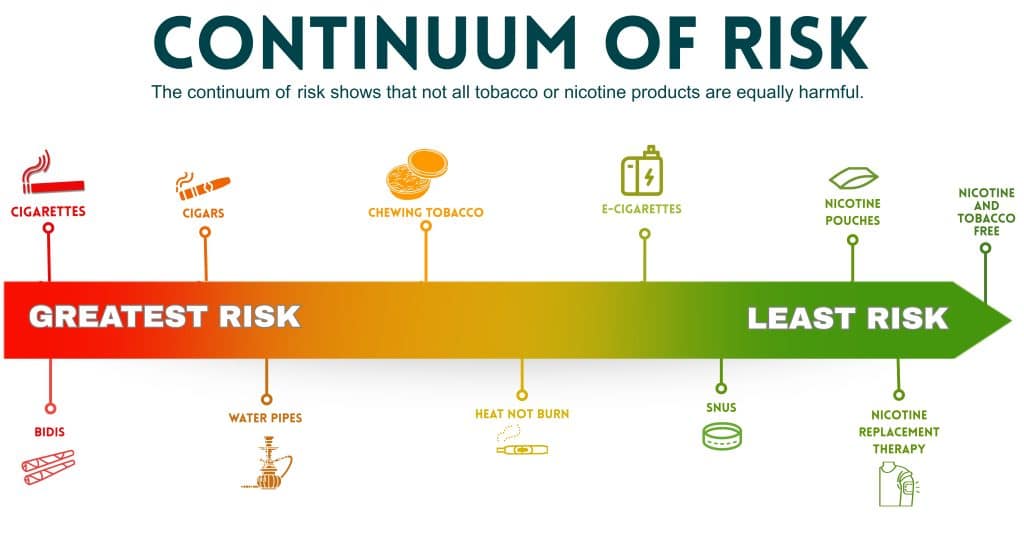
Not all nicotine products carry the same health risks—so what would a framework for quitting smoking based on those relative risks look like? In a nutshell: tobacco harm reduction.

Harm reduction generally acknowledges that some behaviors exist along a continuum of risk, and that individuals can take steps to lower their risk if they choose to engage in those behaviors. For example, drug harm reduction includes syringe service programs, overdose prevention measures, and medication-assisted treatment. These interventions aim to reduce the most serious harms associated with substance use—without requiring or discouraging abstinence.

Tobacco harm reduction (THR) applies the same logic. It doesn’t require, or even necessarily encourage, complete abstinence from nicotine. Instead, it focuses on helping people move away from the riskiest behavior: smoking combustible cigarettes. The only goal is to help people stop smoking—however they choose to do it.

Traditional smoking cessation programs often rely on nicotine replacement therapies, like patches or gum, to help reduce cravings. That’s actually one form of tobacco harm reduction. Using e-cigarettes or nicotine pouches is another. In all of these cases, the individual is switching to a less risky way of using nicotine.

I spent the early years of my career focused on drug harm reduction—specifically, working alongside people who used injection drugs to reduce their risks of HIV and hepatitis C. I liked being part of a public health solution that collaborated with individuals who needed personalized support, rather than telling them what to do from afar.

Submit a question on the latest quitting research, and we may answer it in an upcoming newsletter.

CLICK HERE TO SEND US YOUR ANSWER

Image citations: Murket et al. 2022Knowledge Action Change, 2020, and Kozlowski and Abrams, 2016.

Over time, it became clear to me that the concept of harm reduction should be applied to other areas, including nicotine use. After all, the individuals I worked with are 1.5 to 3 times more likely to smoke than the general population.

Global Action to End Smoking is one of the few public health groups dedicated to ending smoking that fully embraces tobacco harm reduction (THR). We recognize that nicotine products fall along a continuum of risk. While using no nicotine products is the safest option, we also understand that may not be possible for everyone who struggles to quit smoking—and that some adults may choose to use nicotine in the long run.

Like traditional smoking cessation groups, we believe that youth must be protected from nicotine addiction in any form. But it’s clear to us that new solutions are needed to meet the needs of more than one billion people worldwide who still smoke cigarettes.

Global Action funds projects that empower adults to move down the continuum of risk with accurate information about the different health risks of various tobacco and nicotine products. Currently, we’re working with groups like the National Harm Reduction Coalition to integrate THR into existing drug harm reduction initiatives.

This is just the beginning. There’s so much more to do in this space, and we’re excited to continue accelerating the end of the global smoking epidemic by working with people who smoke to reduce their risks.

All my best,

Elsa Larson, PhD, M.S

Director, Programs

Global Action to End Smoking

By the Numbers

Global Action in the news

There may be more responsibility, say, for an organization like Global Action to End Smoking … to communicate about the relative risks of nicotine with folks, and to provide unvarnished, clear, understandable information to all who may need it.

—Global Action CEO Cliff Douglas as he sat down with YouTuber Nick “Grimm” Green to discuss the future of tobacco harm reduction and how compassion for people who smoke will win in the long run.

Tobacco and health around the world

Country snapshot:South Korea

In 2022, an estimated 17.9% of the population of the Republic of Korea, including 30.9% of men and 5.1% of women, smoked cigarettes.

  • Demand for cigarettes in South Korea has decreased by 45.6% since 2010. Euromonitor estimates that the demand for cigarettes per capita was reduced from 110.3 packs in 2010 to 49.6 packs in 2022.
  • In 2021, 3.2% adults aged 19 years and over in the country were identified as current e-cigarette users, comprising 1.2% of women and 5% of men.
  • According to the National Tobacco Control Center, smoking prevalence in adults aged 19 years and over has shown a decline from 27.1% in 2011 to 19.3% in 2021.

For references and to view other country profiles, visit our pages on  

Tobacco and Health Around the World.

Thank you for your support

Give the gift of a healthier tomorrow.

We are taking bold action to find global solutions to end death and disease caused by tobacco, particularly combustible cigarettes. We are one of the only public health groups to embrace tobacco harm reduction as the best viable strategy for ending the global smoking epidemic.

We’re proud to support grantees such as Knowledge Action Change, which recently published this free course on tobacco harm reduction. 

Your support makes this work possible. Together, we can build a future where no one suffers from tobacco-related disease.

Donate Here

Thank you for your support in the fight against smoking.

Get to Know Global Action

Global Action has awarded more than 175 grants to institutions that support the work of over 100 scientists, covering 46 countries on four continents.

Our organization is an independent, U.S. nonprofit 501(c)(3) grantmaking organization whose mission is to end combustible tobacco use, which remains the leading preventable cause of death globally. Through September 2023, Global Action received charitable gifts from PMI Global Services Inc. Global Action does not seek or accept funding from companies that produce tobacco or non-medicinal nicotine products.

To learn more about our work, visit our website.

Disclaimer: This newsletter does not provide medical advice. The information, including but not limited to, text, graphics, images and other material contained in this newsletter are for informational and educational purposes only and does not constitute providing medical advice or professional services. No material in this newsletter is intended to be a substitute for diagnosing or treating a health problem or disease. Those seeking personal medical advice should consult with a licensed physician or other qualified health care provider. Always seek the advice of your licensed physician or other qualified health care provider regarding a medical condition or with any questions you may have regarding treatment and before undertaking a new health care regimen. Never disregard professional medical advice or delay in seeking it because of something you read in this newsletter. No physician-patient relationship is created by this newsletter. Global Action doesn’t make representations, express or implied, with respect to the information provided here.

Categories
Newsletter

Tobacco Harm Reduction Helps People Quit

Global Action to End Smoking Logo

Global Action Community Newsletter

Tobacco Harm Reduction Helps People Quit

So why don’t more public health groups embrace it?

Earlier this month, data from the U.S. Centers for Disease Control and Prevention revealed one of the greatest public health wins in recorded history: In 2023, the smoking rate for adults reached its lowest level in 60 years.

According to a new report, just 7.9% of adults smoked cigarettes exclusively. Since 2017, this number dropped from 26.6 million to 19.8 million, translating to a reduction of 6.8 million adults.

Yet the accompanying report didn’t see this news as positive. Instead, the authors focused on the fact that over the same period of time, the number of adults who exclusively used e-cigarettes increased by 7.2 million. In other words, “current tobacco product use among adults has not changed since 2017.”

This is where Global Action stands apart from traditional public health: We see this news as a victory. Every decline in smoking puts us one step closer to our goal—eliminating all death and disease caused by smoking.

Submit a question on the latest quitting research, and we may answer it in an upcoming newsletter.

CLICK HERE TO SEND US YOUR ANSWER

Global Action is working to unlock the public health potential of tobacco harm reduction. We support people who smoke and can’t or otherwise won’t quit to transition to far less harmful alternatives, including e-cigarettes.

A growing body of strong scientific evidence indicates e-cigarettes help adults who smoke quit at higher rates than traditional nicotine replacement therapies. The highly regarded Cochrane Review analyzed over 88 studies to conclude that “there is high certainty that nicotine EC [e-cigarettes] increases quit rates compared to nicotine replacement therapy.” In the U.S., the Food and Drug Administration (FDA) has also made it clear that generally, products like e-cigarettes and nicotine pouches are less harmful than cigarettes.

Real-world evidence also shows the benefit of tobacco harm reduction. Sweden, for example, has the lowest smoking rate in Europe—an achievement widely attributed to the popularity of snus, a noncombustible tobacco product. The FDA has also concluded the use of several snus products “instead of cigarettes puts you at a lower risk of mouth cancer, heart disease, lung cancer, stroke, emphysema, and chronic bronchitis.”

Despite this, many countries have banned the sale of snus, and the U.S. public health community has largely failed to acknowledge snus would present much less risk for people who transition from cigarette smoking.

We see reduced-risk nicotine products as vital tools to help fight the leading cause of preventable death right alongside traditional nicotine replacement therapies and other cessation supports. Rather than shy away from these successes, public health groups must embrace tobacco harm reduction to move adults away from smoking.

All my best,

Jeff Willett

VP, Strategic Engagement

Global Action to End Smoking

By the Numbers

7.9%

The number of adults in the United States who reported exclusively smoking cigarettes in 2023, according to new data from the U.S. Centers for Disease Control and Prevention. This translates to about 19.8 million people, and it is the lowest level of cigarette smoking among U.S. adults in 60 years.

The country’s national objective for it’s Healthy People 2030 goal is for smoking rates to reach 6.1% or lower. Based on the CDC’s current estimates, the country will likely meet or exceed those current goals.

Get the facts

Three containers of Zyn nicotine pouches

Are nicotine pouches dangerous?

Global health authorities have concluded that nicotine pouches, which do not contain tobacco, are significantly less risky than cigarettes.

Nicotine pouches fit in a person’s mouth. They contain nicotine, the addictive stimulant in tobacco, and some flavorings, but not the dangerous chemicals found in combustible tobacco products.

Global health authorities in some parts of the world, including the U.S., have concluded that nicotine pouches are appropriate for the protection of public health, which means that the potential benefits for adults who smoke in switching outweigh the potential risks to youth or those who have never used nicotine. They are a form of tobacco harm reduction.

Similar to e-cigarettes, nicotine pouches are not risk-free. Nicotine should not be used by anyone who has never used it before—especially youth.

More answers to common questions about nicotine and tobacco use can be found on Global Action’s Get the Facts page.

Tobacco and health around the world

Mostar, Bosnia and Herzegovina

Country snapshot: Bosnia and Herzegovina

In 2022, an estimated 28.2% of the population of Bosnia and Herzegovina, including 33% of men and 23.6% of women, smoked cigarettes. In 2021, it was estimated that tobacco was the 2nd highest risk factor driving the most death and disability combined in the country.

  • Tobacco was responsible for an estimated 6.7 thousand deaths, which is about 26.5% of total deaths.
  • Of tobacco-related deaths, 5.8 thousand or 87.0% were due to smoking, and 1.2 thousand or 17.3% were due to secondhand smoke.
  • Heated tobacco products are available and regulated as other smoking tobacco products, subject to the same regulations as combustible cigarettes.

For references and to view other country profiles, visit our pages on  

Tobacco and Health Around the World.

Thank you for your support

Give the gift of a healthier tomorrow.

We are taking bold action to find global solutions to end death and disease caused by tobacco, particularly combustible cigarettes. We are one of the only public health groups to embrace tobacco harm reduction as the best viable strategy for ending the global smoking epidemic.

We’re proud to support grantees such as Knowledge Action Change, which recently published this free course on tobacco harm reduction. 

Your support makes this work possible. Together, we can build a future where no one suffers from tobacco-related disease.

Donate Here

Thank you for your support in the fight against smoking.

Get to Know Global Action

Global Action has awarded more than 175 grants to institutions that support the work of over 100 scientists, covering 46 countries on four continents.

Our organization is an independent, U.S. nonprofit 501(c)(3) grantmaking organization whose mission is to end combustible tobacco use, which remains the leading preventable cause of death globally. Through September 2023, Global Action received charitable gifts from PMI Global Services Inc. Global Action does not seek or accept funding from companies that produce tobacco or non-medicinal nicotine products.

To learn more about our work, visit our website.

Disclaimer: This newsletter does not provide medical advice. The information, including but not limited to, text, graphics, images and other material contained in this newsletter are for informational and educational purposes only and does not constitute providing medical advice or professional services. No material in this newsletter is intended to be a substitute for diagnosing or treating a health problem or disease. Those seeking personal medical advice should consult with a licensed physician or other qualified health care provider. Always seek the advice of your licensed physician or other qualified health care provider regarding a medical condition or with any questions you may have regarding treatment and before undertaking a new health care regimen. Never disregard professional medical advice or delay in seeking it because of something you read in this newsletter. No physician-patient relationship is created by this newsletter. Global Action doesn’t make representations, express or implied, with respect to the information provided here.