

Global Action Community Newsletter
“I carried a lot of shame as someone who smoked. But since transitioning from smoking to vaping, I’m proud of myself, and I have renewed confidence.”
– Janine from Canada
Overcome misinformation by reading the news like an expert.
Quitting smoking is hard, and the journey is only further complicated by an abundance of online information, not all of which is reliable. News articles are a great starting place to begin your research journey, but the media landscape isn’t perfect: Some stories present relevant, accurate information, but others rely on flashy headlines or rushed reporting that lack the nuance you need to make an informed decision.
At Global Action, we believe the best information comes from the latest research itself. You can find the tools you need by exploring the science yourself—even if you’re not a scientist—with these simple tricks.
First, you need to find the papers themselves. You can either begin searching through a scientific journal database like PubMed, or through a quick news search. Articles from credible news outlets will link to the original papers they are writing about. Be wary of news stories that don’t provide a link to any of the research they discuss.
Ideally, you’d be able to evaluate the full text of the research to determine how much weight to give it. But if you don’t have time or access to the full text, the abstract—a brief section at the beginning of every research paper—can tell you a lot.
Submit a question on the latest quitting research, and we may answer it in an upcoming newsletter.
CLICK HERE TO SEND US YOUR ANSWER
Abstracts serve as an outline of the paper. They should be able to give you background information on the issue at hand, an overview of how the research was conducted, topline results, and what the results mean.
As you’re reading through these first few paragraphs, ask yourself what you can assess from the work. Was this a trial with human participants, or animal or cell models? Or is the study a data analysis, in which researchers accessed an existing body of work and used statistics to try to find a relationship between certain behaviors and outcomes? How many people or data points were included?
After you understand what the study was testing, skip ahead to the end of the abstract. Generally, the last sentences will show you what conclusions the authors came to. Ask yourself: Given how the researchers carried out this trial, and what I already know, does this conclusion make sense?
You can always go back and skim the rest of the abstract for other details that may fully describe the work. No study is perfect, and it’s important to see if you can find the limitations to what you can know from a paper. Asking yourself these basic questions is a start that gives you a rough sense of what each individual paper can—and can’t—tell you.
To learn more about how best to read a scientific abstract for yourself, check out our detailed guide here. Happy reading!
All my best,

Elsa Larson, PhD, M.S.
Director of Programs,
Global Action to End Smoking
The big idea
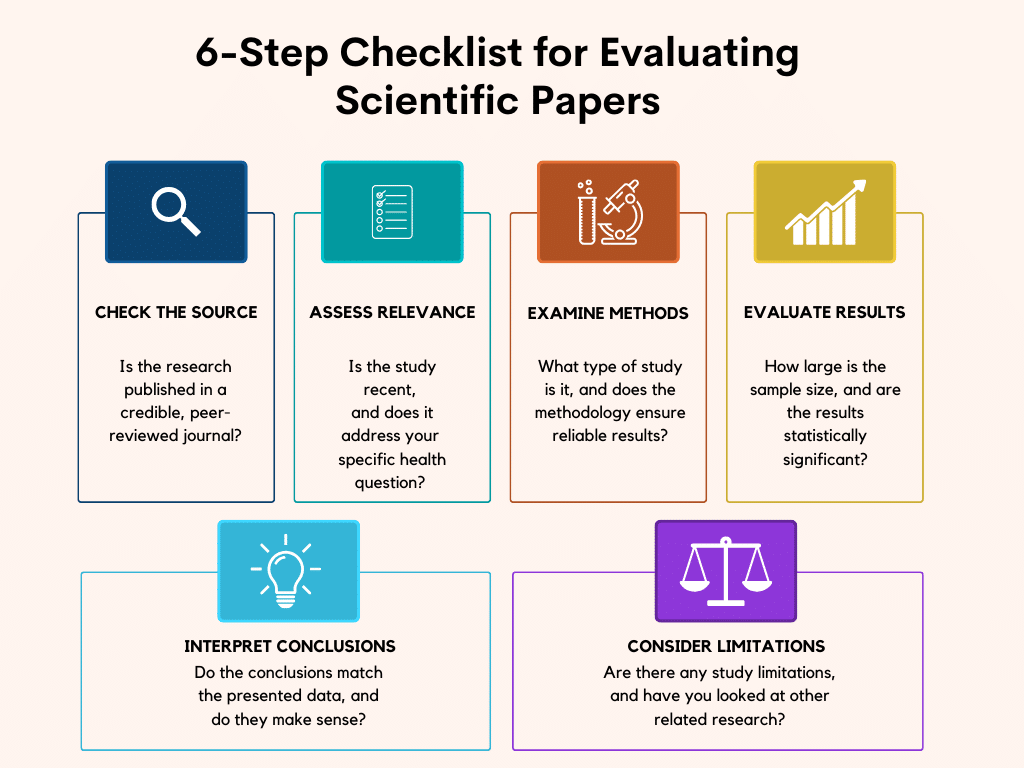
Read science like a scientist
As you see new headlines or scientific papers about nicotine use or smoking cessation, ask yourself the following questions to get the most out of the work.
Learn More About Reading Scientific Articles Here
By the Numbers
of physicians globally mistakenly think nicotine causes COPD.
76%
Research conducted by Sermo and supported by Global Action found that in 2022, the majority of more than 15,000 doctors across 11 countries mistakenly believe that nicotine is responsible for the adverse health conditions including chronic obstructive pulmonary disease.
In reality, tobacco and nicotine products vary widely how they impact health.
Learn more about the nicotine continuum of risk here.
What’s one question you have about smoking cessation or nicotine use? Click here or the button below to send us your answer or reply to this email. We may even answer it in an upcoming issue.
More from the Global Action Community
“I smoked for 40 years. Every quit attempt failed, and as the failures mounted my confidence depleted to the point where I couldn’t face another failed quit attempt. I quit quitting and resigned myself to an abbreviated life.
One day, on a whim, I purchased an e-cigarette with absolutely no plan to quit smoking. I began with a tobacco flavor. During a two-week period I alternated between cigarettes and vaping. As my stash of cigarettes depleted I used my e-cigarette more often until I reached the last cigarette. That was when I decided to put off buying another pack “just to see.”
I never bought another pack of cigarettes. After many years of failed quit attempts and no plan to try again, I had in fact quit. I became accidental quitter. Thanks to vaping, I have maintained my smoke-free status for 9 years.”Janine from Canada
Congratulations, Janine! The Global Action community is proud of you for reducing your health risks by quitting smoking combustible cigarettes.
Tobacco and health around the world
Country snapshot: The Philippines
In 2022, an estimated 16.4 million adults in the Philippines were tobacco products users. This positions the country as the 15th globally and the 4th in the WHO Western Pacific Region in terms of number of tobacco users.
- Tobacco was responsible for an estimated 88.2 thousand deaths, which is about 22.2% of total deaths.
- Of tobacco-related deaths, 73.0 thousand or 82.8% were due to smoking, and 18.4 thousand or 20.9% were due to secondhand smoke.
For references and to view other country profiles, visit our pages on:
Tobacco and Health Around the World.
watch this
Cliff Douglas, CEO of Global Action to End Smoking, discusses the dramatic decline in youth smoking rates in the U.S. revealed by a recent Gallup survey. Douglas credits traditional tobacco control measures and the shift to much less hazardous alternatives as key contributors to this decline.
Get to Know Global Action
Global Action has awarded more than 175 grants to institutions that support the work of over 100 scientists, covering 46 countries on four continents.
Our organization is an independent, U.S. nonprofit 501(c)(3) grantmaking organization whose mission is to end combustible tobacco use, which remains the leading preventable cause of death globally. Through September 2023, Global Action received charitable gifts from PMI Global Services Inc. Global Action does not seek or accept funding from companies that produce tobacco or non-medicinal nicotine products.
To learn more about our work, visit our website.
Disclaimer: This newsletter does not provide medical advice. The information, including but not limited to, text, graphics, images and other material contained in this newsletter are for informational and educational purposes only and does not constitute providing medical advice or professional services. No material in this newsletter is intended to be a substitute for diagnosing or treating a health problem or disease. Those seeking personal medical advice should consult with a licensed physician or other qualified health care provider. Always seek the advice of your licensed physician or other qualified health care provider regarding a medical condition or with any questions you may have regarding treatment and before undertaking a new health care regimen. Never disregard professional medical advice or delay in seeking it because of something you read in this newsletter. No physician-patient relationship is created by this newsletter. Global Action doesn’t make representations, express or implied, with respect to the information provided here.