

Global Action Community Newsletter
We need to talk about women who smoke.
In my field as a family medicine practitioner and a member of the New York State Academy of Family Physicians, most of my patients who smoke are men. This reflects global trends: women make up only a fraction of the population who smokes.
By now, we all understand that smoking shortens millions of lives. But what we don’t often discuss are the differences in the way these risks impact people of different genders.*
(*To date, most of the scientific literature has classified people in the gender binary. I’m referring to men and women here for simplicity, but I understand that gender is a spectrum.)
As we reflect on Women’s History month, I want to discuss some of smoking’s unique risks to women. We must consider these differences to provide the best care for these patients and their offramp from cigarettes.
Many of the health harms of cigarettes are experienced differently in women and men. Just over a quarter of women worldwide smoke or have smoked before. These women experience most of the same smoking-related health risks as men, including higher rates of cancer and respiratory and cardiovascular diseases.
But other smoking risks are elevated for women specifically. For example, women face additional smoking-related heart health risks. Those who smoke are at a 25% greater risk of developing coronary heart disease than are men who smoke, and they’re more likely to experience a type of heart attack in which the coronary artery is completely blocked. In addition, smoking while taking birth control that contains estrogen elevates the risk of blood clots and heart attacks.
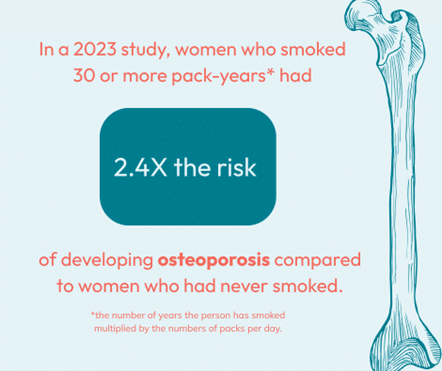
Certain health conditions that primarily afflict women are even more prevalent in women who smoke. For instance, smoking thins bones over time, increasing the risk of osteoporosis. A lifetime of smoking doubles women’s risk of infection with the virus that causes cervical cancer, and it increases the risk of death in women with breast cancer.
Smoking can also harm women’s reproductive systems. Women who smoke may be more likely to develop endometriosis, and to go through early menopause. Smoking increases the chances of complications of becoming pregnant or carrying a pregnancy, such as ectopic pregnancies and preterm delivery.
There’s also evidence that women have a harder time quitting, and that some popular cessation medications work less well for them. One recent study compared the efficacy of three first-line cessation medications: bupropion, nicotine patches, and varenicline. Varenicline was the only one of the three that was just as effective in women as in men, while the other two fell short.
While women may face extra barriers to quitting, research also shows that they have a lot to gain if the goal is achieved. In a large study, after 20 years without cigarettes the risk of sudden cardiac death among women who had smoked previously matched that of women who had never smoked. In another study, women’s lung function improved more than twice that of men’s in the first year after quitting smoking.
Women who smoke deserve healthcare that works for them. That may require providers to think outside the box. When treating women for whom past cessation attempts have failed, it may mean educating them about alternative nicotine solutions such as nicotine e-cigarettes or nicotine pouches.
These innovative solutions, combined with our growing understanding of how cigarettes impact women’s health, present us with the opportunity to provide better care and evidence-based ways to help women quit.

All my best,
Dr. Keasha Guerrier
Family Medicine Practitioner
Member, New York State Academy of Family Physicians
Dr. Keasha Guerrier is a guest contributor for Global Action’s Community Newsletter and the presentation of facts as well as opinions expressed in this article are properly attributed exclusively to Dr. Guerrier.
BY THE NUMBERS
GLOBAL ACTION IN THE NEWS
This month, the U.S. Food and Drug Administration issued draft guidance stating that certain flavored e-cigarettes could be appropriate for the protection of public health if the potential benefits to adults who smoke and want to quit outweigh any potential risk to youth.

Global Action believes that youth must be protected from nicotine addiction. We applaud FDA for recognizing the potential public health benefits of properly authorized and regulated alternative nicotine solutions, as these options could potentially save the lives of millions of adults who otherwise cannot or will not quit smoking. Read our full statement here.
THANK YOU FOR YOUR SUPPORT
Recently, roughly 60 attendees came together at the Benefit-Cost Analysis of Tobacco Harm Reduction in Pokhara, Nepal, hosted by Global Action’s grantee the Prakriti Pragya Foundation.
Dr. Matthew Walker, GA’s program officer, and GA grantee Don Kenkel of Cornell University spoke virtually at this meeting. We are grateful to the Prakriti Pragya Foundation for creating space for thoughtful dialogue and evidence-driven solutions for the one billion adults worldwide who continue to smoke.

Global Action is one of the only public health groups to embrace tobacco harm reduction as a means of meeting adults who smoke where they are, showing them empathy in their individual cessation journeys, and helping them—if they cannot or will not quit—to reduce their risks of death or disease from combustible cigarettes.
Your support increases the impact our grantees’ work can have on this cause. Together, we can build a future where no one suffers from tobacco-related disease
GET TO KNOW GLOBAL ACTION
Global Action has awarded more than 175 grants to institutions that support the work of over 100 scientists, covering 46 countries on four continents.
Our organization is an independent, U.S. nonprofit 501(c)(3) grantmaking organization whose mission is to end combustible tobacco use, which remains the leading preventable cause of death globally. Through September 2023, Global Action received charitable gifts from PMI Global Services Inc. Global Action does not seek or accept funding from companies that produce tobacco or non-medicinal nicotine products.
To learn more about our work, visit our website.
Disclaimer: This newsletter does not provide medical advice. The information, including but not limited to, text, graphics, images and other material contained in this newsletter are for informational and educational purposes only and does not constitute providing medical advice or professional services. No material in this newsletter is intended to be a substitute for diagnosing or treating a health problem or disease. Those seeking personal medical advice should consult with a licensed physician or other qualified health care provider. Always seek the advice of your licensed physician or other qualified health care provider regarding a medical condition or with any questions you may have regarding treatment and before undertaking a new health care regimen. Never disregard professional medical advice or delay in seeking it because of something you read in this newsletter. No physician-patient relationship is created by this newsletter. Global Action doesn’t make representations, express or implied, with respect to the information provided here.